How to Respond to Bad Reviews: Attorney-Led Removal Guide
How to Respond to Bad Reviews: Attorney-Led Removal Guide
If a review is fake, defamatory, or clearly violates platform policy, the most reliable path is an attorney-led, multi-channel removal service. You pay only after the review comes down. That’s the model Repvive operates on: attorney oversight, policy-framed escalation to platform legal support, and subpoena or litigation tools when softer approaches fail.
The three situations that call for this approach immediately:
- A review comes from someone who was never your customer
- The review contains provably false factual claims about your business
- You’re facing impersonation, a coordinated smear campaign, or a competitor attack
Key Takeaways
Attorney-led, pay-per-removal removal is the most reliable path when a review is fake, defamatory, or violates platform policy — and Section 230 means legal pressure targets the reviewer, not the platform.
| Point | Details |
|---|---|
| Preserve evidence first | Screenshot the review, URL, and reviewer profile immediately before anything changes. |
| Screen before pursuing removal | Only fake, defamatory, or policy-violating reviews qualify; honest negatives are protected by the CRFA. |
| Multi-channel escalation works | Policy flag → cease-and-desist → John Doe subpoena → court order; each step raises pressure. |
| Pay-per-removal aligns incentives | No upfront fee means the provider only profits when the review actually comes down. |
| Repvive covers 20+ platforms | Attorney-led removal with RepWatch monitoring and RepBoost review generation for long-term protection. |
This article is general information, not a substitute for advice from a qualified lawyer. Consult a qualified legal professional about your own circumstances before acting on anything here.
Table of Contents
- When should you respond to bad reviews by pursuing removal?
- How does an attorney-led removal process actually work?
- What evidence do attorneys need to build a removal case?
- What U.S. laws and risks apply to review removal?
- What do attorney-led removal services cost, and how long does it take?
- How do you choose the right attorney-led removal provider?
- What should you do after a review is removed?
- What the attorney-led approach gets right that most businesses miss
- Repvive removes the reviews that are hurting your business
- Sources
- FAQ
When should you respond to bad reviews by pursuing removal?
Not every negative review qualifies. Pursuing legal removal for a legitimately unhappy customer’s honest opinion wastes money and can backfire publicly. The Consumer Review Fairness Act protects honest negative reviews, and attorneys who screen cases properly will tell you that upfront.
Review types that typically justify attorney-led removal:
- Fake accounts: Reviews from people with no transaction history with your business
- False factual claims: Specific, verifiable falsehoods (wrong dates, fabricated incidents, invented staff behavior)
- Impersonation: Someone posing as a customer, employee, or competitor
- Confidential disclosures: Reviews that reveal privileged client information, particularly relevant for law firms and medical practices
- Coordinated attacks: Multiple reviews posted in a short window, often from accounts with no prior activity
- Competitor-posted content: False advertising disguised as a customer review
When not to pursue removal: a one-star review that says “food was cold” or “wait time was too long” is protected speech. Attempting removal there risks the Streisand effect, where the public attention you draw to the review does more damage than the review itself.
Pro Tip: Before calling an attorney, run a quick harm assessment. Estimate lost bookings or revenue tied to the review’s star-weight and search prominence. If the number is material, legal removal is worth the conversation. If it’s a single review buried on page three, monitoring may be enough.
How does an attorney-led removal process actually work?
Attorney-led removal follows a structured, multi-channel sequence. The goal is to apply the least invasive tool that achieves removal, then escalate only when needed.
- Evidence investigation. The attorney categorizes every assertion in the review: factual claim, opinion, insult, or coordination signal. Only actionable parts move forward.
- Policy-framed platform report. Google offers separate legal and policy reporting paths; requests that map statements to specific policy categories and include documentary evidence are easiest for moderators to evaluate. This step resolves many cases within days to a few weeks.
- Business Support escalation. When a standard flag fails, attorneys escalate through direct platform channels with a formal legal submission.
- Reviewer outreach and cease-and-desist. A cease-and-desist letter to the reviewer often produces voluntary removal within days to a few weeks, especially when the reviewer understands the legal exposure.
- John Doe subpoena. When reviewers are anonymous, attorneys file John Doe lawsuits to compel platforms or ISPs to disclose identifying information, including IP addresses and account metadata. This phase typically takes weeks to months.
- Court order or litigation. A court order often produces removals when policy flags fail. Full litigation, including Lanham Act claims against competitors, runs months or longer.
Pro Tip: Preserve evidence before you do anything else. Screenshots disappear, review profiles get deleted, and metadata evaporates. Capture everything on day one.
What evidence do attorneys need to build a removal case?
Removal depends on precise, documented evidence. The stronger the file, the faster platform moderators and courts can act.
Core evidence checklist:
- Full-page screenshots of the review, including the reviewer’s profile, post date, and star rating
- Review URL and reviewer profile URL, captured before any edits
- Transaction records showing the reviewer never purchased from you, or records that contradict their claims
- Booking logs, invoices, or service records tied to the date referenced in the review
- Communications (texts, emails, voicemails) between you and the reviewer, if any exist
- Employee schedules and CCTV timestamps when the review describes a specific incident
- Website or server logs showing no account activity from the reviewer
- Pattern documentation for coordinated attacks: multiple reviews, similar language, overlapping posting windows
- Witness statements from staff present during the alleged incident
Pro Tip: Capture raw HTML and preserve metadata alongside screenshots. Use a timestamped chain-of-custody log and store copies offsite. Attorneys turn this file into policy-framed claims that moderators can evaluate in minutes rather than weeks.
What U.S. laws and risks apply to review removal?
Platforms are generally shielded under Section 230 of the Communications Decency Act, which means legal pressure targets the reviewer, not the host. That shapes the entire strategy.
Key laws and rules every business owner should understand:
- Section 230 (CDA): Platforms are not liable for third-party content. You cannot sue Google to force removal; you need a court order or a successful policy flag.
- Consumer Review Fairness Act (CRFA): Protects honest negative reviews. Pursuing removal of a protected opinion can expose you to public backlash and legal risk.
- FTC Trade Regulation Rule (effective October 21, 2024): Prohibits creating or distributing fake reviews and carries civil penalties. This cuts both ways: it’s a tool against fake-review actors, and a warning against any temptation to manufacture positive reviews in response.
- Lanham Act (15 U.S.C. §1117(a)): Applies when a competitor posts false advertising disguised as a review. Remedies can include injunctive relief and treble damages in willful cases.
The Streisand effect is a real operational risk. Public legal threats draw attention to reviews that most searchers would never find. Discreet, evidence-backed outreach consistently outperforms public posturing.
State defamation standards vary. Some states require proof of actual malice; others apply a negligence standard. An attorney familiar with your state’s law will screen cases accordingly.
What do attorney-led removal services cost, and how long does it take?
Repvive operates on a pay-per-removal model: no upfront fee, payment only after a review is successfully removed. That structure aligns the provider’s incentive directly with your outcome.
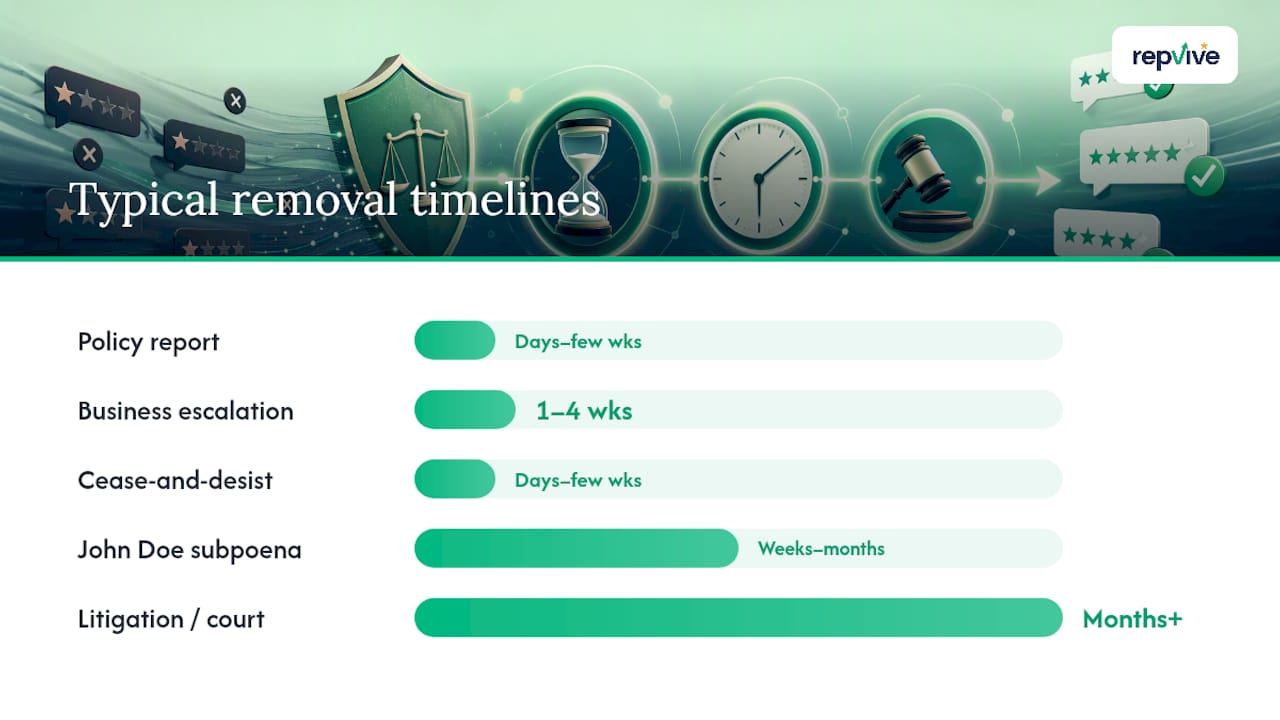
| Channel | Typical Timeline | Notes |
|---|---|---|
| Policy flag / platform report | Days to a few weeks | Fastest path; works when evidence clearly maps to a policy violation |
| Business Support escalation | 1–4 weeks | Requires formal legal submission |
| Cease-and-desist to reviewer | Days to a few weeks | Often resolves without further escalation |
| John Doe subpoena | Weeks to months | Required for anonymous reviewers |
| Litigation / court order | Months or longer | Reserved for high-value or willful cases |
Before signing any contract, confirm these terms:
- Exact definition of “removed” (delisted, hidden, or permanently deleted)
- What happens if removal fails (refund, retry, or credit)
- Data handling and confidentiality provisions
- Whether monitoring and escalation are included or billed separately
The benefits of removing negative reviews for local businesses extend beyond star ratings: search ranking, conversion rates, and customer trust all shift when damaging content disappears.
How do you choose the right attorney-led removal provider?
Pick a provider that combines documented legal experience in defamation and subpoenas, direct platform relationships, and transparent pay-per-removal terms. A methodical investigation followed by targeted legal tools is the standard that separates capable providers from reputation-management shops that lack legal authority.
Questions to ask on your first call:
- Have your attorneys handled John Doe subpoenas and defamation litigation?
- Which platforms do you cover? (Minimum: Google, Yelp, Facebook, TripAdvisor, Trustpilot, BBB)
- What is your documented success rate, and how do you define success?
- Do you charge upfront, or only after removal?
- How do you handle cases that require escalation to litigation?
- What does your reporting dashboard show, and how often is it updated?
Red flags to walk away from:
- Guaranteed removal promises with no legal process described
- Requests to generate fake positive reviews as part of the strategy
- Large upfront retainers with no performance guarantee
- No documented case history or verifiable success rate
- Pressure to sign quickly without reviewing contract terms
What should you do after a review is removed?
Removal is one step. Without active monitoring and a compliant review-generation plan, a single coordinated attack can undo months of reputation work. The durable goal is authentic positive reviews and continuous monitoring to reduce the impact of anything that remains.
Monitoring essentials:
- Real-time alerts across 20+ platforms
- Dashboard reporting with escalation triggers for sudden review spikes
- Automated flagging when new reviews match known attack patterns
For review generation, integrate requests into your natural client offboarding. Ask at the moment of highest satisfaction, remove friction (a direct link to your Google profile), and never incentivize reviews. Incentivized reviews violate both the CRFA and FTC rules, and the risk of a penalty far outweighs any short-term star-count gain.
Pro Tip: Schedule quarterly audits of your review profiles across all platforms. A sudden spike of three or more reviews in 48 hours is a reliable signal of a coordinated attack. Catching it early compresses the response timeline significantly.

For healthcare practices, the constraints around patient review responses add HIPAA considerations that make attorney oversight especially valuable.
What the attorney-led approach gets right that most businesses miss
Most business owners, when they first encounter a damaging fake review, instinctively want to respond publicly or threaten legal action loudly. Both moves tend to make things worse. A public response to a defamatory review can inadvertently confirm details the reviewer fabricated. A public legal threat triggers the Streisand effect.
The attorney-led model works precisely because it operates quietly. Evidence is gathered, claims are categorized, and the appropriate channel is selected based on what the review actually says and who posted it. Cases that look identical on the surface often require completely different tools. A competitor-posted Lanham Act case and an anonymous fake-customer case both show up as one-star reviews, but they follow entirely different legal paths.
The pay-per-removal structure matters for a second reason beyond cost: it forces the provider to screen cases honestly. A provider who only gets paid on success has no incentive to pursue a review that won’t come down.
Repvive removes the reviews that are hurting your business
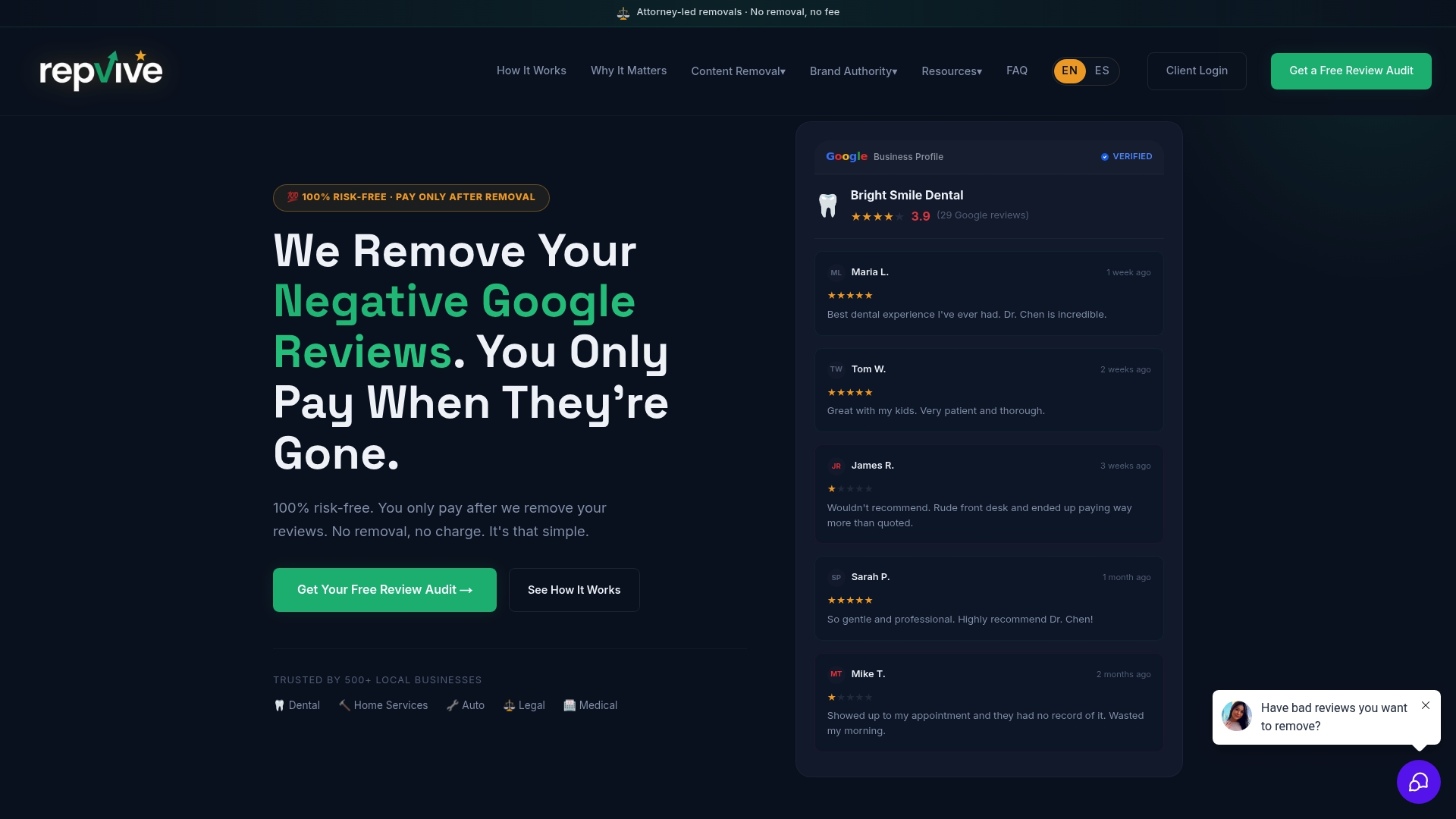
Repvive’s attorney-led team handles the full removal workflow across Google, Yelp, Facebook, TripAdvisor, Trustpilot, the BBB, and more than 20 additional platforms. Every case starts with a legal review of the review itself. You pay nothing until the review is gone.
RepWatch, Repvive’s real-time monitoring tool, keeps watch after removal so you’re not caught off-guard by a follow-up attack. RepBoost supports compliant review generation to rebuild your rating with authentic feedback.
Request a case evaluation at Repvive. The intake is straightforward: share the review, describe the business impact, and the legal team will tell you whether the case qualifies and which removal channel applies. No upfront fee, no retainer.
Sources
- How to Handle Defamatory Google Reviews: A Legal Guide for Businesses | Chambers and Partners
- Business Review Removal Lawyer | Article | Chambers and Partners
- A Lawyer’s Guide to Removing False Google Reviews | Maryland State Bar Association
- Google legal troubleshooter - report content for removal
- Can My Business Sue Over Negative or Fake Online Reviews? - KJK
- Negative review removal | Jackie Lacey insights
FAQ
When does a bad review qualify for legal removal?
A review qualifies when it contains provably false factual claims, comes from someone who was never your customer, involves impersonation, or is part of a coordinated attack. Honest negative opinions are protected under the Consumer Review Fairness Act and do not qualify.
How long does attorney-led review removal take?
Policy-based removals can resolve in days to a few weeks. Cases requiring a cease-and-desist or John Doe subpoena typically take weeks to months, and full litigation runs longer depending on complexity.
What is a pay-per-removal model?
A pay-per-removal model means you owe nothing until the review is successfully removed. Repvive operates this way, billing per confirmed removal with no upfront retainer.
Can Google be sued to force a review down?
No. Section 230 of the Communications Decency Act shields platforms from liability for third-party content. Legal action targets the reviewer, not Google, and removal is achieved through platform policy enforcement or a court order.
What happens if the reviewer is anonymous?
Attorneys file a John Doe lawsuit to obtain a subpoena compelling the platform or ISP to disclose the reviewer’s identifying information, such as IP address and account metadata, enabling further legal action.