Google vs Yelp Reviews: Which Platform Actually Matters?
Google vs Yelp Reviews: Which Platform Actually Matters?
Google reviews win on reach and discovery. Yelp wins on depth and category-specific credibility. For most U.S. businesses, that means Google is the platform you cannot afford to neglect, while Yelp is the one you cannot afford to ignore if you run a restaurant, salon, or any service that draws heavy foot traffic in a major metro.
Three facts frame everything that follows. First, Google holds a dominant share of all online reviews globally, and its integration with Search and Maps means your star rating appears before a potential customer even clicks your website. Second, Yelp’s recommendation filter quietly hides a substantial share of submitted reviews, which directly affects the average rating a consumer sees. Third, the two platforms attract meaningfully different users: Google draws a broad cross-section of the population, while Yelp skews toward engaged, detail-oriented reviewers who write longer, more opinionated content.
The sections below cover the comparison table, why ratings diverge, how to evaluate a review’s trustworthiness, what each platform does to your local search ranking, how to dispute a fake or unfair review, and when a DIY flag isn’t enough.
Key Takeaways
Google reviews drive discovery for most U.S. businesses, while Yelp delivers category-specific credibility that matters most in restaurants, beauty, and urban hospitality markets.
| Point | Details |
|---|---|
| Google dominates reach | Google holds a dominant share of online reviews globally and feeds directly into local pack rankings. |
| Yelp filters aggressively | Yelp’s recommendation algorithm hides an estimated 25–30% of reviews, making visible ratings more curated but sometimes lower. |
| Rating gaps are structural | Higher Google scores often reflect low posting friction and rating inflation, not necessarily better service quality. |
| DIY flags have limits | Standard flagging works for obvious policy violations; defamatory or coordinated fake reviews often require attorney-led removal. |
| Repvive for hard cases | Repvive’s pay-per-removal, attorney-led service handles reviews that survive the standard platform appeal process. |
Table of Contents
- How Google Reviews and Yelp compare at a glance
- How Google Reviews and Yelp actually work
- Why Google scores are often higher than Yelp scores
- Which platform is more trustworthy, and how to evaluate a single review
- How reviews shape your visibility on Google Maps and Yelp listings
- When DIY removal fails: what attorney-led services actually do
- The case for treating both platforms as separate problems
- Repvive removes the reviews that platforms won’t
- Useful sources
- FAQ
How Google Reviews and Yelp compare at a glance
| Dimension | Google Reviews | Yelp |
|---|---|---|
| Who can post | Any Google account holder | Any Yelp account holder, but reviewer history affects visibility |
| Friction to post | Very low — one tap from Maps | Low to moderate — new accounts face heavier filtering |
| Volume and rating patterns | Higher volume; ratings skew higher on average | Lower volume per business; ratings tend to be more critical |
| Moderation approach | Policy-based removal; no automatic filter | Recommendation algorithm hides ~25–30% of reviews |
| Fake review susceptibility | Higher — easier to post at scale | Lower visible impact — filter catches many inauthentic reviews |
| Appeal tools for businesses | Flag for removal via Google Business Profile; formal appeal process | Business owner tools; “not recommended” reviews visible via link |
| Local search impact | Direct ranking signal in Google local pack | Feeds Apple Maps; strong in category-specific organic results |
| Advertising options | Google Ads, Local Services Ads (pay-per-lead) | Yelp Ads (cost-per-click); free and paid tiers |
| Core user demographic | General public, all ages | Urban, mid-adult, higher income, dining/lifestyle-focused |
Key takeaways from the table:
- Google’s low posting friction drives volume but also invites manipulation; Yelp’s filter reduces fake positives at the cost of hiding some legitimate reviews.
- A business with a 4.8 on Google and a 3.9 on Yelp is not necessarily better or worse than its scores suggest — the platforms measure different slices of customer opinion.
- For home services, healthcare, and retail, Google dominates; for restaurants, beauty, and hospitality in dense urban markets, Yelp still carries real weight.
- Advertising on Google gives you reach across Search and Maps; Yelp advertising keeps you visible within a high-intent, category-browsing audience.
- Both platforms offer business-owner response tools, but the removal and appeal processes differ substantially in speed and success rate.
How Google Reviews and Yelp actually work
Who can post and how friction shapes quality
Posting a Google review requires only a Google account, which virtually every smartphone user already has. That near-zero friction is Google’s biggest strength and its biggest vulnerability. Yelp requires an account too, but its recommendation algorithm weighs a reviewer’s history, social connections, and activity level before deciding whether a review appears publicly. A brand-new Yelp account that posts one review and disappears has a high chance of landing in the “not currently recommended” section, invisible to most visitors.
The practical result: Google accumulates reviews faster, but Yelp’s stricter curation means the reviews that do show up tend to come from people with a track record on the platform.
Content policies in brief
- Google: prohibits fake, spam, off-topic, and conflict-of-interest reviews; enforcement is reactive (flagging triggers human or automated review). The Google Business Profile help center outlines prohibited content in detail.
- Yelp: prohibits solicited reviews, incentivized reviews, and content from people with a conflict of interest; enforcement is both algorithmic (the recommendation filter) and reactive. The Yelp support center explains how the filter works.
Core use cases
Google functions as a discovery engine. When someone searches “dentist near me,” your star rating and review count appear in the local pack before they visit any website. Yelp functions as a validation tool: users who already know the category they want use it to compare options in depth, read detailed narratives, and check photos.
Pro Tip: If you want to understand how your Yelp profile looks to a casual visitor versus a determined researcher, open your listing in a private browser window. Scroll to the bottom and click “not currently recommended reviews” — that hidden section often contains legitimate feedback that never counted toward your visible average.
Why Google scores are often higher than Yelp scores
The gap between a business’s Google rating and its Yelp rating is one of the most common points of confusion in any Google reviews comparison. Several forces drive it.
Sampling differences
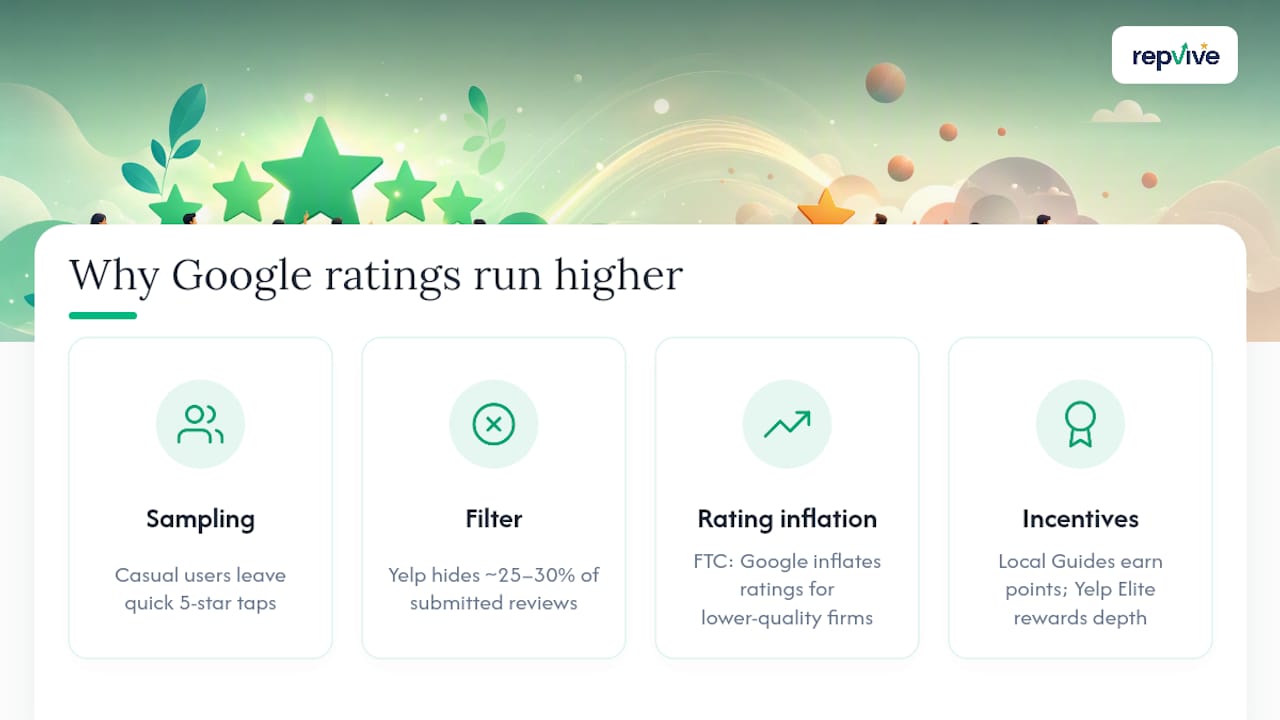
Google’s reviewer pool is enormous and relatively casual. Many people leave a quick 5-star tap after a positive experience without writing a word. Yelp attracts reviewers who are motivated enough to write — and motivated reviewers are disproportionately people who had a strong reaction, positive or negative. Average Yelp reviews are significantly longer than those on Google, which reflects a fundamentally different kind of engagement.
The filter effect
Yelp’s recommendation algorithm removes roughly 25–30% of submitted reviews from the visible count. When those hidden reviews skew positive (which they often do for newer accounts posting their first review after a great experience), the visible average drops. Business owners frequently report that their best reviews are the ones that get filtered — a frustrating but documented pattern.
Platform-level rating inflation
An FTC economist’s analysis found that Google and Facebook reviews show inflated ratings for lower-quality businesses compared to Yelp’s distribution. The mechanism: Google’s low posting friction means happy customers post easily, while dissatisfied customers on Google are less likely to write a detailed critique than they would be on Yelp.
Behavioral incentives
Google Local Guides earn points and badges for posting reviews, which nudges casual users toward leaving quick, positive ratings. Yelp Elite members are selected for consistent, high-quality writing — a different incentive structure that rewards depth over volume.
Stat to know: Yelp estimates its recommendation filter affects a substantial share of submitted reviews, which means the visible rating on any Yelp listing reflects a curated subset, not the full picture.
Which platform is more trustworthy, and how to evaluate a single review
Neither platform is immune to manipulation. Investigative reporting has documented suspicious review activity on Yelp, and Google’s high volume makes it a frequent target for coordinated fake-review campaigns. The question isn’t which platform is “safe” — it’s how to read a review critically on either one.
A practical trustworthiness checklist
- Reviewer history: Does the account have a history of reviews across multiple businesses, or is this their only post? A single-review account on Google is a yellow flag.
- Review length and detail: Specific details (a server’s name, a particular dish, a wait time) are hard to fabricate at scale. Vague praise (“great place, loved it!”) is easy to manufacture.
- Photo and video evidence: Attached photos that match the business’s actual interior or menu add credibility. Stock-looking images or photos that appear on multiple listings do not.
- Consistency across platforms: If a business has a 4.9 on Google and a 2.8 on Yelp, that divergence warrants investigation rather than dismissal of either score.
- Timing patterns: A cluster of five-star reviews posted within 48 hours, especially after a long gap, is a classic signal of a coordinated campaign.
Pew Research’s work on how people triage online information supports a layered approach: use Google’s star rating as a quick first filter, then go to Yelp (or another platform) for the detailed narrative that confirms or contradicts that initial signal.
Pro Tip: Search the reviewer’s name or profile image on Google Images. Fake reviewer accounts sometimes reuse profile photos across multiple platforms, and a reverse image search takes about 10 seconds.
How reviews shape your visibility on Google Maps and Yelp listings
Google Search and Maps: the local pack
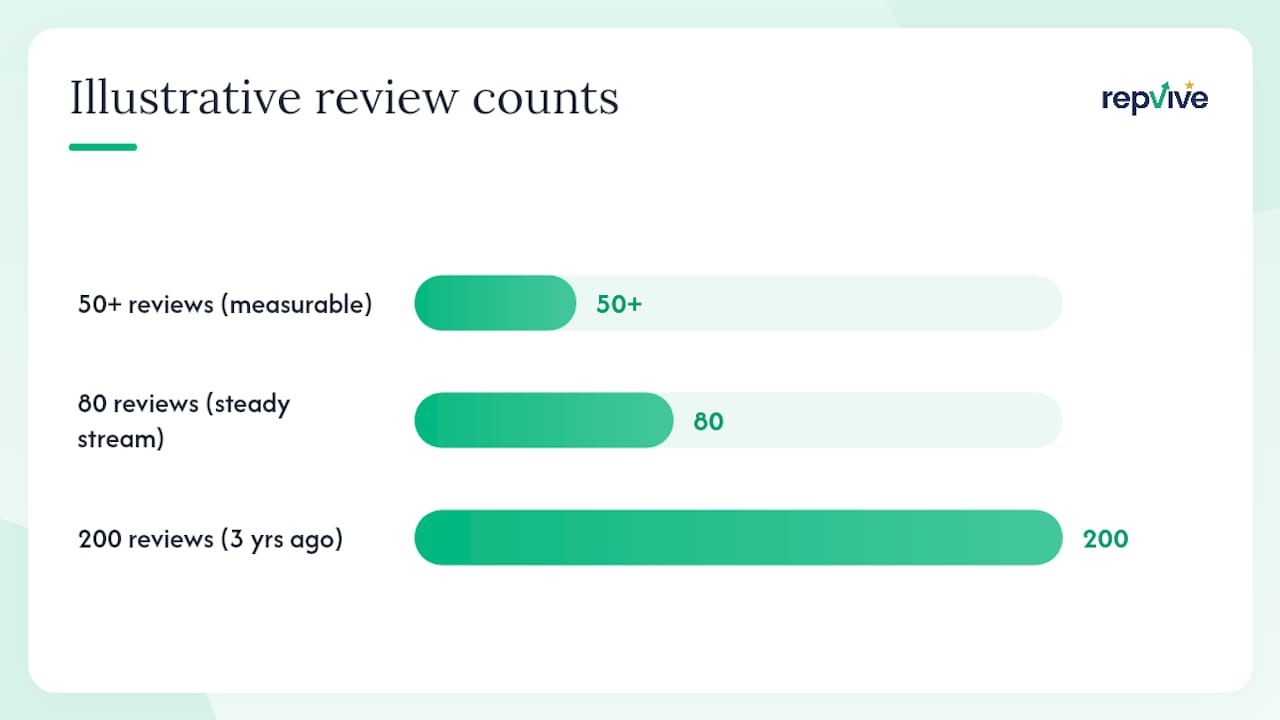
Google’s local ranking algorithm weighs three factors: relevance, distance, and prominence. Reviews feed directly into prominence. A Google Business Profile with a high review count, strong average rating, and recent activity ranks higher in the local pack than a sparse or stale profile. Listings with 50 or more reviews show measurable increases in calls and walk-ins according to industry reporting. Review recency matters too — a business that earned 200 reviews three years ago and has collected nothing since will lose ground to a competitor with 80 reviews and a steady stream of new ones.
Yelp’s SEO footprint
Yelp pages rank organically in Google Search for category-plus-location queries, often appearing on page one. Yelp also powers Apple Maps star ratings, which matters for iPhone users who never open Google Maps. For restaurants, the Yelp effect is especially pronounced: a strong Yelp profile can drive significant reservation and walk-in traffic independent of any Google ranking.
| Platform | Primary visibility channel | Key ranking inputs | Ad product |
|---|---|---|---|
| Local pack, Maps, Search | Review count, recency, rating, GBP completeness | Google Ads, Local Services Ads | |
| Yelp | Yelp search, organic Google results, Apple Maps | Review count, rating, profile completeness, check-ins | Yelp Ads (CPC), enhanced profiles |
Where to focus by industry
For home services, healthcare, legal, and retail, Google is the primary battleground. For restaurants, bars, salons, and hospitality in cities like New York, Chicago, or Los Angeles, Yelp’s category-specific influence remains strong enough to justify active profile management. A restaurant owner who ignores Yelp because “Google is bigger” is leaving a meaningful slice of reservation traffic on the table.
Proactive review collection — asking satisfied customers to post on the platform that matters most for your category — is the single highest-return activity for most small businesses. Consistent reputation monitoring keeps you ahead of problems before they compound.
When DIY removal fails: what attorney-led services actually do
Standard flagging works for clear-cut policy violations. It fails when a review is defamatory but technically compliant with platform content policies, when a competitor has run a coordinated fake-review campaign, or when a business has already exhausted the self-service appeal process without result.
How attorney-led removal works
Professional legal removal services investigate each review individually rather than applying a generic template. The process typically involves:
- Analyzing the review for defamation, false statements of fact, or policy violations that a layperson might miss.
- Drafting a customized legal claim or takedown notice tailored to the specific review and the platform’s legal and policy framework.
- Submitting through direct platform channels that bypass the standard consumer-facing flag queue.
- Escalating to litigation or formal legal demand when platform channels are exhausted.
What to look for when vetting a service
- Success rate with documented outcomes, not just testimonials.
- Pay-per-removal pricing with no upfront fees — you pay only when the review is actually gone.
- A real-time tracking dashboard so you can see the status of each removal in progress.
- Transparency about what they cannot remove — no legitimate service guarantees removal of every review, only those that meet legal or policy grounds.
- Customized claims per review, not a one-size-fits-all template.
A business that has tried the self-service route and received a rejection should consider whether the review contains a false statement of fact (not just a negative opinion), whether it was posted by a competitor or disgruntled former employee, or whether it violates platform policy in a way that requires legal framing to articulate clearly. Those are the situations where customized review removal claims outperform a DIY flag by a wide margin.
Pro Tip: Before hiring any removal service, ask for a written breakdown of how they will approach your specific review — not a general description of their process. A service that cannot explain why your review qualifies for removal before you pay is not one worth hiring.
The case for treating both platforms as separate problems
Most of the debate around Google vs. Yelp reviews frames it as a choice: pick one, optimize for it, and move on. That framing misses the actual risk.
The more useful question isn’t which platform matters more in the abstract — it’s which platform is currently hurting you. A single defamatory review on Yelp can dominate the first page of Google Search results for your business name for months, because Yelp pages rank organically. A coordinated fake-negative campaign on Google can tank your local pack position in weeks. These are different problems that require different responses, and neither one resolves itself.
What I’ve seen consistently is that business owners underestimate how long a damaging review stays visible and overestimate how quickly a platform will act on a flag. Google’s enforcement is real but slow and inconsistent for individual cases. Yelp’s filter catches a lot of fake positives but does almost nothing about fake negatives posted by accounts with enough history to look legitimate.
The practical recommendation: treat Google as your primary reputation asset and protect it accordingly. Maintain an active Yelp profile if your category warrants it. And if a review survives two rounds of flagging and a formal appeal, stop waiting for the platform to fix it — that’s the moment to bring in legal expertise. The cost of professional removal is almost always less than the revenue a damaging review costs you over six months.
Repvive removes the reviews that platforms won’t
When a negative review survives every flag and appeal you can file, the standard advice runs out. Repvive’s attorney-led removal service is built for exactly that situation: reviews that are defamatory, fake, or policy-violating but haven’t been removed through the normal process.
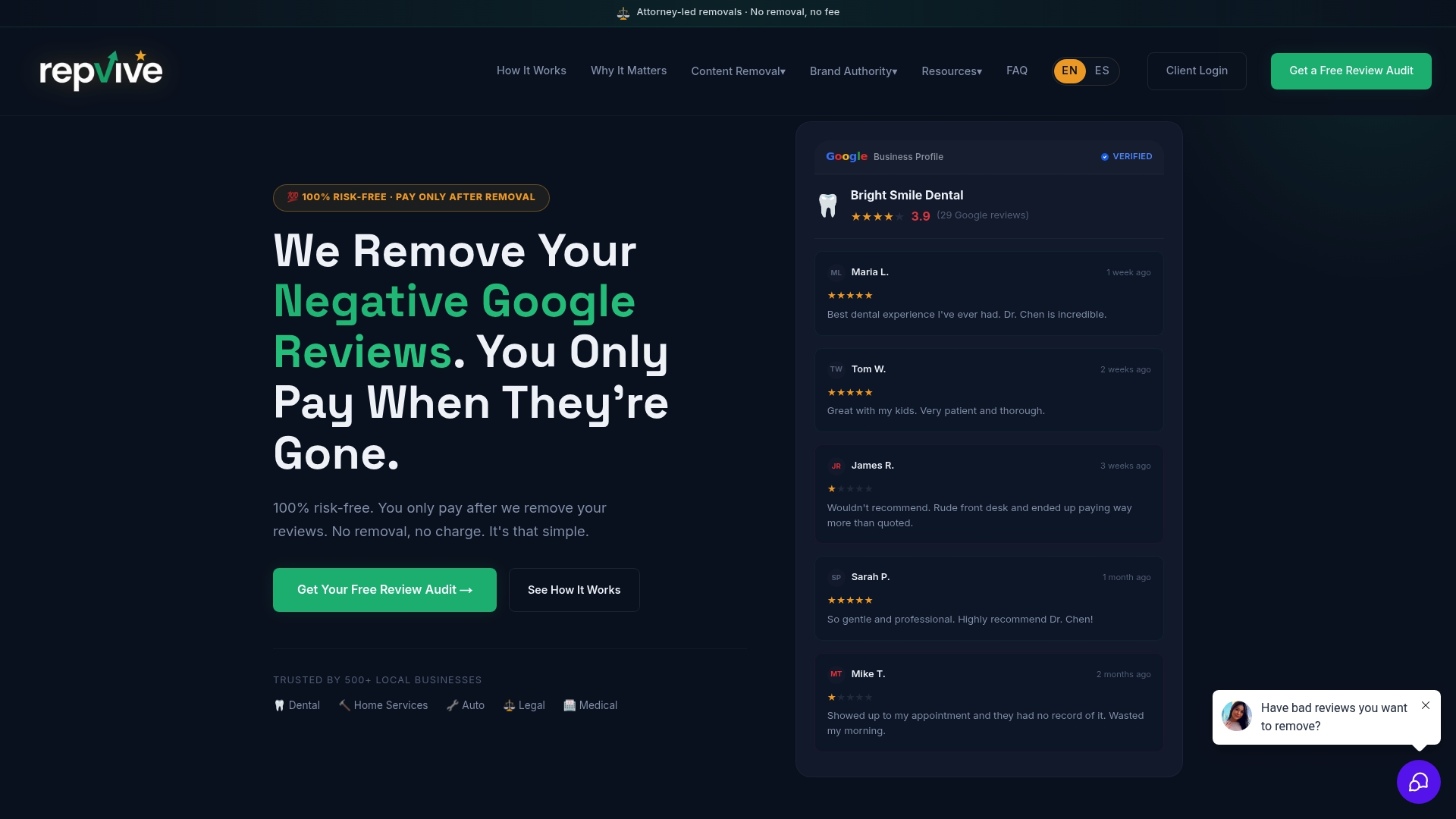
The model is straightforward. Repvive’s legal team analyzes each review individually, drafts a customized claim, and submits through direct platform channels. You pay nothing upfront — the fee applies only after the review is successfully removed. A real-time dashboard shows you exactly where each case stands. The service covers Google, Yelp, Facebook, TripAdvisor, Trustpilot, BBB, and more than 20 other platforms.
If you have a review that’s costing you customers and the platform hasn’t acted, get a free case evaluation at Repvive to find out whether it qualifies for attorney-led removal.
Useful sources
- Yelp vs Google Reviews: Which Matters? | Ansview
- Google Reviews vs. Yelp: Which Are Better & Why? — Podium
- theverge.com
- FTC economist finds Google and Facebook have inflated reviews for low-quality businesses
- Yelp vs Google Maps reviews comparison — The Tech Edvocate
- Yelp vs Google Reviews: Which Platform Actually Matters More for Local SEO in 2026? | Flento
- Yelp vs Google Business Profile: Which Matters More? | DataLatte
FAQ
What is the most trustworthy review site?
Neither Google nor Yelp is definitively more trustworthy across all categories. Google’s volume makes it more susceptible to fake campaigns, while Yelp’s recommendation filter reduces some manipulation but can hide legitimate reviews. Cross-referencing both platforms gives you a more accurate picture than relying on either alone.
Does anybody use Yelp anymore?
Yes, particularly for restaurants, salons, and hospitality businesses in major U.S. cities. Yelp pages also rank organically in Google Search and power Apple Maps ratings, so a business’s Yelp score reaches consumers who never open the Yelp app directly.
Why are Google reviews so much higher than Yelp reviews?
Google’s low posting friction attracts more casual, positive reviewers, and an FTC economist’s analysis found Google ratings tend to be inflated for lower-quality businesses compared to Yelp. Yelp’s recommendation filter also removes roughly 25–30% of submitted reviews, which often skews the visible average downward.
Is it better to advertise on Google or Yelp?
For most U.S. businesses, Google Ads and Local Services Ads reach a larger audience and integrate directly with Search and Maps. Yelp advertising works best for restaurants, bars, and service businesses targeting high-intent category browsers in urban markets. The two are not mutually exclusive, but Google typically delivers broader reach per dollar spent.
When should a business hire a professional review removal service?
When a fake or defamatory review survives two rounds of platform flagging and a formal appeal, DIY options are effectively exhausted. Attorney-led services like Repvive use customized legal claims and direct platform channels to remove reviews that the standard process cannot reach, with no upfront fees.