Google Review Removal Cost: What Local Businesses Pay
Google Review Removal Cost: What Local Businesses Pay
TL;DR:
- Removing fake or harmful reviews varies from free DIY flagging to expensive legal action depending on the situation. Google does not sell removals; paid services provide expertise and legal leverage, not a backdoor payment. When reviews violate policies or contain false factual claims, professional help becomes justified to minimize reputation damage.
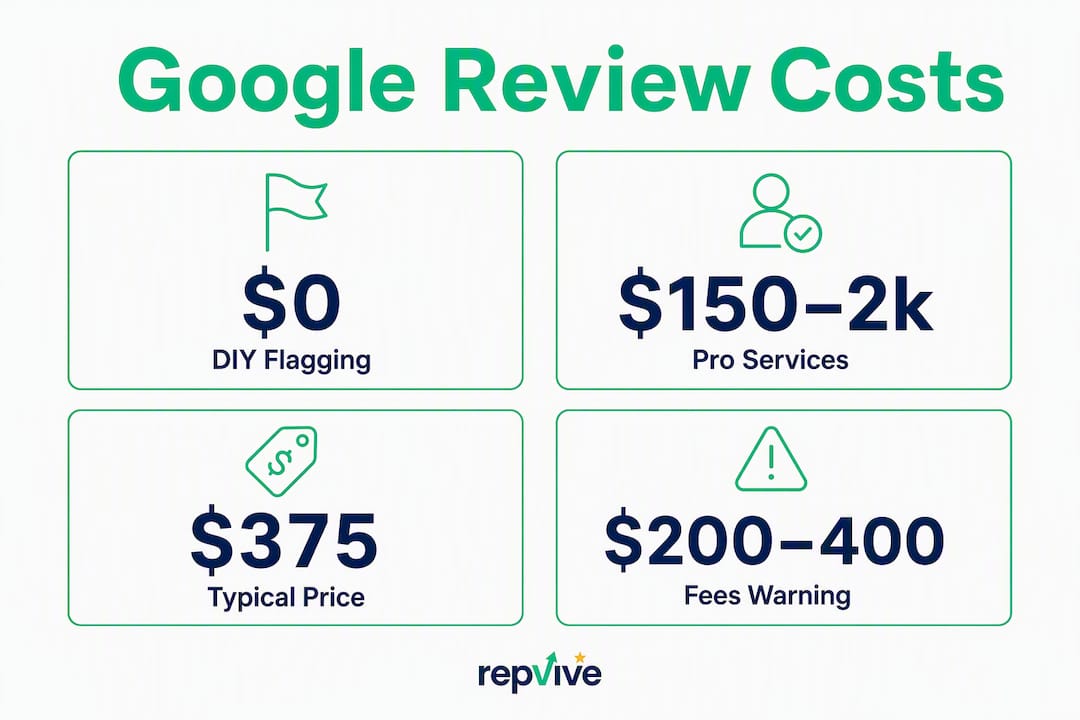
Expect to pay anywhere from free (DIY flagging) to high litigation costs depending on the route you take. The most common vendor fee for a single review falls within a moderate range, with many services advertising a standard price point per removal. Here’s the critical thing to understand upfront: Google does not sell removals. When you pay a vendor, you’re paying for their expertise, their legal leverage, or their process — not a backdoor payment to Google.
The quick verdict:
- DIY flagging: Free. Works when a review clearly violates Google Business Profile policy. Takes days to weeks, with no guarantee.
- Per-review vendor fees: Often a moderate fee range. You’re paying for case assessment, policy matching, and escalation skills.
- Subscription review tools: Usually a monthly fee for monitoring and guided submissions.
- Attorney demand letters: Legal fees can vary widely. Litigation costs are substantial, but court-ordered removals are legally enforceable.
Try DIY first if the review is obviously fake or spam. Hire a paid service when the review is causing real business harm and you’ve already tried flagging. Bring in an attorney when the content is defamatory and you need enforceable legal recourse. Repvive’s attorney-led, pay-after-success model sits in that final category — and charges nothing until the review is actually gone.
Table of Contents
- How does Google review removal actually work?
- What does Google review removal actually cost?
- How to try removing a Google review yourself
- When should you hire a paid service or attorney?
- What attorney-led removal looks like in practice
- What to do when removal isn’t possible
- How long does removal take, and what do guarantees actually mean?
- Anonymized case examples: cost vs. outcome
- Key Takeaways
- Why the attorney-led model is the right call for high-stakes cases
- Repvive’s pay-after-success removal service
- Useful sources
- FAQ
How does Google review removal actually work?
Google’s removal process runs through a few distinct channels, and understanding which one applies to your situation determines both your cost and your odds of success.
The official flagging path starts inside Google Business Profile. You log in, find the review, click the flag icon, and submit a report citing the specific policy violation. Google’s moderation team reviews it, usually within a few days. If they agree the review violates policy, it comes down. If they don’t, you get a denial with no explanation.

Escalation to Google Small Business Support is the next step most business owners skip. Escalating to live support with clear, documented evidence that directly matches a policy category significantly improves outcomes compared to a single flag submission. This is where a well-organized evidence package starts to matter.
Legal channels are the final escalation. A court order compelling removal is legally enforceable and bypasses Google’s discretionary moderation entirely. This path is slower and more expensive, but it’s the only route that guarantees an outcome when Google’s moderators won’t act.
Google’s own policy is clear: reviews are removed only when they violate specific content rules — spam, fake content, off-topic posts, restricted content, illegal content, terrorist content, sexually explicit material, offensive content, dangerous content, impersonation, or conflicts of interest. Disagreeing with what a reviewer wrote is not a policy violation. Proving the review is false is not enough on its own.
What Google will not remove:
- Negative opinions, even harsh ones, expressed as personal experience
- Factual disputes without supporting evidence of a policy violation
- Reviews that feel unfair but don’t break a specific rule
- One-star ratings with no text (these are technically allowed)
Platform moderators do not adjudicate factual disputes — they evaluate whether content violates a specific policy category. A review that says “worst dentist I’ve ever visited” is an opinion. A review that names a staff member and accuses them of a crime they didn’t commit is potentially impersonation or illegal content. The distinction matters enormously for your removal strategy.
The same logic applies on Yelp. Yelp explicitly states it does not take sides in factual disputes — but it will act on a court order from a jurisdiction with competent authority. Yelp review removal cost follows a similar structure to Google’s: free to flag, expensive to litigate.
What does Google review removal actually cost?
The price you pay depends almost entirely on which removal channel you use and how complex your case is. Here’s how the four main options break down.
| Service type | Typical U.S. cost | Expected timeline | Success rate note |
|---|---|---|---|
| DIY flagging (Google Business Profile) | Free | Several days to two weeks | High for clear policy violations; low for opinion-based reviews |
| Per-review vendor (no attorney) | $150–$2,000 per review | Several weeks | Varies widely; case selection affects reported rates |
| Subscription review management tool | ~$49/month | Ongoing | Not a removal service; improves monitoring and guided submissions |
| Attorney demand letter | Legal fees vary | Few weeks | Strong for legally actionable content |
| Litigation / court order | Litigation costs vary widely | Several months to over a year | Enforceable when granted; high cost, high certainty |
What drives the price up:
- Violation type. A clear spam review is easier to remove than a defamatory claim that requires legal analysis.
- Evidence collection. Cases requiring IP tracing, transaction records, or third-party verification cost more.
- Number of reviews. Multiple listings across platforms multiply vendor fees quickly.
- Legal escalation. The moment an attorney drafts a demand letter, costs jump to the $500–$2,000 range.
- Urgency. Rush handling typically adds a premium.
Professional removal services typically charge $150–$2,000 per review, with some vendors advertising $375 as a common price point and retainer packages for more complex or multi-review cases. Whether it’s worth it depends on what the review is costing you in lost business.
Pro Tip: Before paying anyone, run a quick calculation. If a single bad review is visibly suppressing your star rating and you can estimate lost monthly revenue, compare that figure to the vendor fee. A $500 removal that recovers $2,000/month in bookings pays for itself in two weeks.
One important warning: some “no-win-no-fee” vendors include nonrefundable evaluation or administrative fees of $200–$400 in the fine print. Always read the full contract before providing payment details. A true pay-after-success model charges nothing until the review is confirmed removed.
How to try removing a Google review yourself
Before spending a dollar, run through this checklist. DIY flagging works when the review clearly violates policy — and it costs nothing but time.
Step-by-step:
- Document everything immediately. Screenshot the review with the reviewer’s name, star rating, date, and full text visible. Capture the URL from your browser bar. Note the timestamp.
- Match the review to a specific policy violation. Don’t just flag it as “false.” Identify the exact category: spam, fake content, conflict of interest, illegal content, hate speech, or impersonation. Google’s moderators need a policy hook, not your frustration.
- Gather supporting evidence. Transaction records showing the reviewer was never a customer, IP data if available, screenshots of similar reviews posted in a pattern, or any public information that contradicts the review’s claims.
- Flag through Google Business Profile. Log in, navigate to Reviews, find the review, click the three-dot menu, and select “Report review.” Choose the most accurate violation category.
- Wait 3–7 days. Google will email you the outcome. If approved, the review comes down. If denied, move to step 6.
- Escalate to Google Small Business Support. Contact support directly, reference your case number, and submit your evidence package. A live agent reviewing documented evidence has more discretion than the automated moderation pass.
- Respond publicly while you wait. A calm, professional public response signals to potential customers that you take feedback seriously. It also creates a record that you disputed the review.
Evidence to collect:
- Screenshots with timestamps (multiple angles if possible)
- Transaction records or appointment logs showing no customer relationship
- Proof of reviewer identity if they’ve posted similar fake reviews elsewhere
- Any communications that contradict the review’s claims
Pro Tip: Don’t wait more than 48 hours to start this process. Google’s systems weight recency, and a fresh flag with strong evidence moves faster than one filed weeks later. If the review is clearly fake, act the same day it appears.
When should you hire a paid service or attorney?
DIY flagging is the right first move. But there are situations where paying for professional help is the smarter call.
Pay for help when:
- You’ve already flagged and been denied, and the review is causing measurable harm
- The review contains false factual statements (not just opinions) that you can document
- The same reviewer or a coordinated group has posted multiple attacks across platforms
- You’re a high-visibility business where a single review materially affects your star rating
- You lack the time or internal capacity to build a proper evidence package
Questions to ask any vendor before paying:
- What is your specific evidence strategy for my case?
- Do you use attorneys, or is this a manual flagging service?
- What exactly is guaranteed: the process, or the outcome?
- What are the refund terms if the review stays up?
- Are there any fees before the review is removed?
- Which platforms do you cover, and is Google Business Profile explicitly included?
- Can you show anonymized case outcomes similar to mine?
Red flags that signal a scam:
- Guarantees removal of any review, regardless of content
- Asks you to post fake positive reviews to offset the negative one
- Charges a large nonrefundable fee before doing any work
- Uses pressure tactics (“act within 24 hours or the price doubles”)
- Cannot name the specific policy violation they’ll pursue
- Testimonials that are unverifiable or suspiciously generic
Trust signals worth looking for: attorney involvement in the process, a documented pay-after-success model with no upfront fees, transparent per-review pricing, a named list of covered platforms, and anonymized case studies with real outcomes.
Pro Tip: Ask specifically whether the vendor’s “guarantee” covers the outcome or just the process. A process guarantee means they’ll file the flag — which you can do yourself for free. An outcome guarantee means you pay only when the review is gone.

What attorney-led removal looks like in practice
Attorney-led removal is a different category from standard vendor services. The process, the leverage, and the cost structure are all distinct.
How it typically works:
- Case intake and evidence review. An attorney or legal team reviews the review, the reviewer’s history, and your documentation to assess whether the content is legally actionable (defamation, impersonation, illegal content) versus merely negative opinion.
- Customized legal claim. Rather than submitting a generic flag, the attorney drafts a claim that maps the review’s specific content to the applicable policy violation or legal standard. This is what separates attorney-led services from manual flagging.
- Direct platform legal channels. Attorneys have access to legal escalation paths that standard users don’t. Google and other platforms maintain legal request processes that carry more weight than a consumer flag.
- Court orders when necessary. If platform channels fail, an attorney can pursue a court order compelling removal. This is the only path that is legally enforceable regardless of platform discretion.
Attorney-led vs. standard vendor vs. DIY:
| Approach | Cost | Speed | Enforceability | Best for |
|---|---|---|---|---|
| DIY flagging | Free | Fast (days) | None | Clear policy violations |
| Per-review vendor | $150–$2,000 per review | Moderate (weeks) | None | Spam, fake reviews with evidence |
| Attorney-led | $500–$2,000 for demand letters; litigation $3,000–$10,000+ | Moderate to slow | High (court orders) | Defamation, false factual claims |
One important distinction: attorney action is appropriate for false factual statements and legally actionable content. It is not the right tool for a negative opinion, even a scathing one. An attorney who tells you they can remove any review regardless of content is overpromising.
Repvive’s model sits at the intersection of attorney-led rigor and accessible pricing. Their attorney-led Google review removal service uses customized legal claims for each review, charges nothing upfront, and bills only after a successful removal. They report a high success rate, and coverage extends across Google, Yelp, Facebook, TripAdvisor, Trustpilot, BBB, and many other platforms.
Pro Tip: When evaluating an attorney-led service, ask whether the legal claim is customized per review or templated. A templated claim filed across hundreds of cases carries far less weight with platform legal teams than one that maps your specific review to a specific legal standard.
What to do when removal isn’t possible
Not every negative review qualifies for removal. When a review is a genuine opinion — even an unfair one — your options shift from takedown to damage control.
Respond publicly and professionally. A measured, factual public response does two things: it signals to future customers that you’re engaged and accountable, and it creates a visible counterpoint to the negative claim. Keep it short, avoid defensiveness, and offer to resolve the issue offline. Something like: “We’re sorry to hear this didn’t meet your expectations. Please contact us directly at [contact] so we can make it right.”
Generate genuine positive reviews. A single 1-star review has far less impact when it sits among 50 recent 4- and 5-star reviews. Tools like RepBoost (part of Repvive’s suite) automate the process of requesting reviews from satisfied customers at the right moment in the service cycle. Proactive reputation management through consistent review collection is often cheaper than paying per-removal fees repeatedly.
Improve local SEO visibility. A higher volume of positive reviews improves your position in Google’s Local Pack, which pushes the negative review further down the visible stack. This is a slower play, but it compounds over time.
Monitor and alert. RepWatch (Repvive’s monitoring tool) sends real-time alerts when new reviews appear, so you can respond within hours rather than days. Speed of response matters for both platform algorithms and customer perception. Subscription review management tools that automate policy-matching and alerting typically charge a monthly fee — often less than the cost of a single per-removal service.
Mediation and direct outreach. For reviews from real customers with a genuine complaint, direct outreach to resolve the issue sometimes results in the reviewer updating or removing the review voluntarily. This is the cheapest possible outcome and worth attempting before any paid service.
If your reputation issues are affecting your business valuation or a potential sale, the stakes are higher than a single review. Unresolved reputation damage can materially reduce what a buyer will pay — another reason to address it proactively rather than reactively.
How long does removal take, and what do guarantees actually mean?
Timelines vary significantly by method, and most vendor “guarantees” need careful reading before you trust them.
Typical timelines:
- DIY flagging: 3–14 days for an initial decision. Escalation to Small Business Support adds another 1–2 weeks.
- Per-review vendor: 2–6 weeks, depending on case complexity and whether escalation is needed.
- Attorney demand letter: 2–8 weeks for platform response. Platforms generally respond faster to legal requests than consumer flags.
- Litigation and court order: 3–18 months. This is the slowest path, but the outcome is legally binding.
What “success rate” actually means:
Vendors who report high success rates are often reporting on cases they accepted, not all cases submitted. A service that only takes clear-cut spam reviews will naturally show a higher success rate than one that takes on contested defamation cases. How success rates are measured matters as much as the number itself.
Evaluating guarantees:
- Does the guarantee cover the outcome (review removed) or the process (flag submitted)?
- What triggers a refund — and how quickly is it issued?
- Is there a time limit on the guarantee?
- Are there categories of reviews excluded from the guarantee?
- What happens if Google removes the review and then reinstates it?
A genuine outcome-based guarantee with a clear refund policy is a meaningful trust signal. A process guarantee is worth nothing you couldn’t do yourself.
Industry caution: Experts advise against panic-buying removal services after a single bad review. A combined approach — policy-based dispute filing alongside proactive positive review collection — is often faster and more cost-effective than a single paid removal.
Anonymized case examples: cost vs. outcome
These examples illustrate how different situations translate into different costs and results.
| Case | Method | Cost | Timeline | Outcome |
|---|---|---|---|---|
| Restaurant: competitor posted fake 1-star reviews with no text | DIY flagging (spam category) | Free | 5 days | 3 of 4 reviews removed |
| Dental practice: former employee left defamatory review naming staff | Attorney demand letter via Repvive | Pay-per-removal, no upfront | 3 weeks | Review removed; no litigation needed |
| Auto shop: real customer dispute, negative opinion only | Public response + review generation | Monthly subscription fee | Ongoing | Rating improved substantially over several months |
| Law firm: coordinated attack across Google and Yelp (6 reviews) | Attorney-led multi-platform removal | Pay-per-removal | 5 weeks | 5 of 6 reviews removed; 1 required further escalation |
What made each case winnable or not:
- The restaurant case succeeded because fake reviews with no text and no customer history are textbook spam violations. Evidence was easy to document.
- The dental practice case worked because the content made a specific false factual claim about a named employee — legally actionable, not just negative opinion.
- The auto shop case had no removal path because the review reflected a real customer’s genuine (if harsh) experience. Reputation repair was the only viable strategy.
- The law firm case showed that coordinated attacks across platforms benefit most from an attorney-led service with multi-platform coverage, like Repvive’s Yelp removal service running in parallel with Google removal.
Evidence quality was the single biggest predictor of success across all four cases. Cases with transaction records, timestamps, and clear policy-violation mapping succeeded. Cases built on “I know this reviewer is lying” without documentation did not.
Key Takeaways
Paying for Google review removal makes sense only when the review is legally actionable or clearly violates policy — and the right model charges nothing until the review is confirmed gone.
| Cost range by method | DIY is free; vendor fees typically range from $150 to $2,000 per review; attorney litigation can be expensive ($3,000–$10,000+). | Google doesn’t sell removals | Every paid service sells expertise or legal leverage, not a payment to Google. | | Evidence quality decides outcomes | Cases with transaction records, timestamps, and clear policy-violation mapping succeed; opinion-based reviews rarely qualify. | | Guarantees need scrutiny | Outcome guarantees (pay after removal) are meaningful; process guarantees (we’ll file the flag) are not. | | Repvive’s attorney-led model | Pay-per-removal with no upfront fees, customized legal claims, and high reported success rate across many platforms. |
Why the attorney-led model is the right call for high-stakes cases
Most of the advice you’ll find online about removing negative Google reviews treats it as a technical problem: flag the review, follow up, repeat. That framing misses the real issue for local businesses. A defamatory review isn’t a platform moderation problem — it’s a legal one. And solving a legal problem with a non-legal tool is why so many business owners end up paying $375 for a flag submission they could have done themselves.
The attorney-led model matters because it changes the nature of the claim. A generic flag says “I think this violates policy.” A customized legal claim, drafted by an attorney who has reviewed the specific content and mapped it to a specific legal standard, says something entirely different to a platform’s legal team. Platforms respond differently to those two inputs.
The pay-after-success structure is also genuinely important, not just as a marketing angle. It aligns the vendor’s incentive with yours. A service that charges $400 upfront regardless of outcome has no skin in the game. A service that charges only on confirmed removal is betting on its own process.
For small and mid-sized local businesses — dentists, contractors, restaurants, law firms — the reputational stakes of a single defamatory review are disproportionately high. A one-star drop in average rating can measurably reduce customer inquiries. The Harvard Business School research on online reviews and restaurant revenue showed that even a half-star improvement in rating produces a meaningful revenue effect. The cost of inaction is real, even when it’s invisible on a balance sheet.
Repvive’s pay-after-success removal service
If you’ve already tried flagging and the review is still up, or if the content is defamatory and you need legal leverage, Repvive is built for exactly that situation. No upfront fees. No retainers. You pay only after the review is confirmed removed.
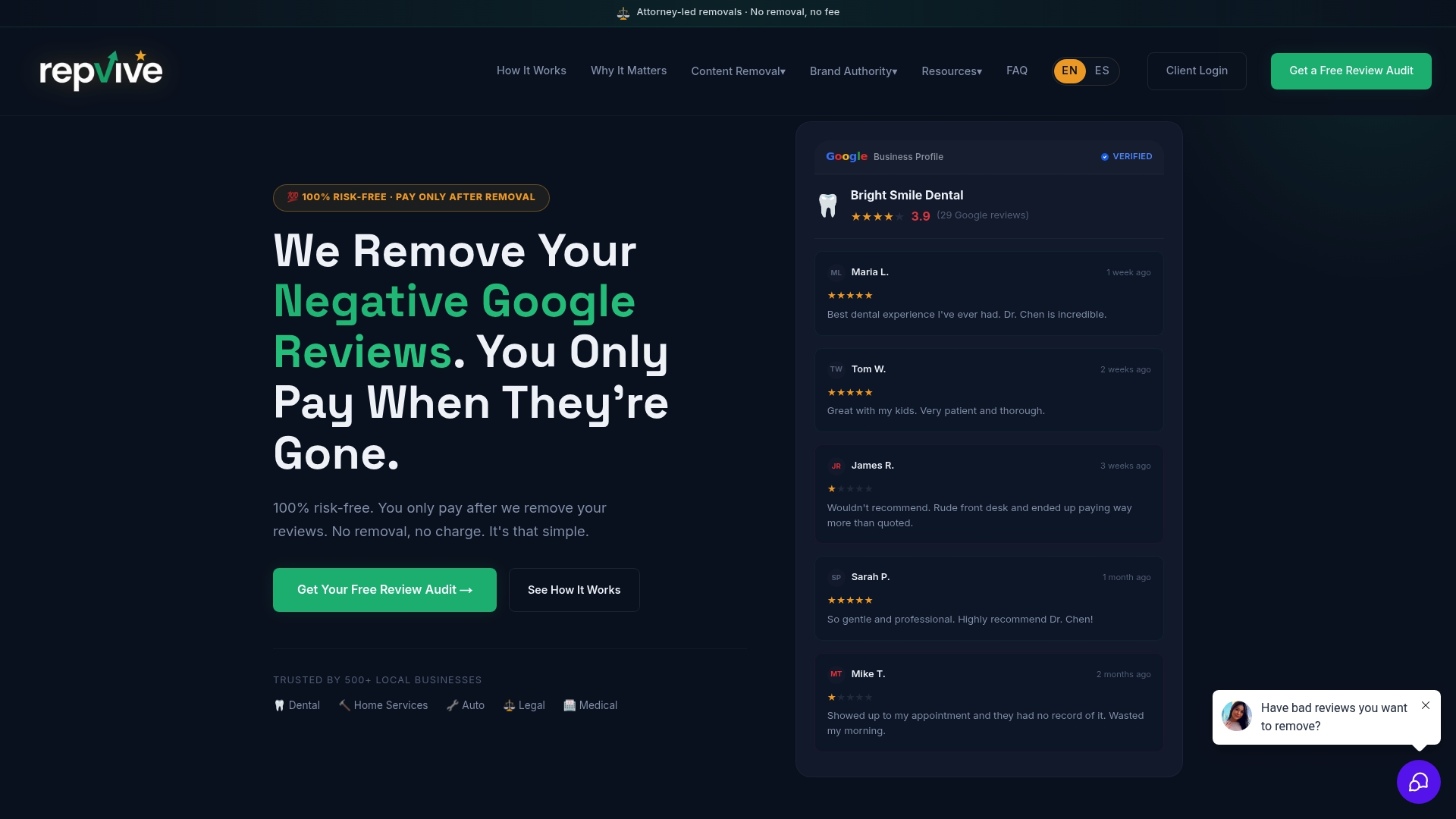
The intake process is straightforward: submit the review permalink, your screenshots, and any transaction records that document the situation. Repvive’s legal team reviews the case, identifies the applicable legal claim, and handles the escalation through direct platform legal channels. If litigation is needed, that option is on the table. Coverage spans Google, Yelp, Facebook, TripAdvisor, Trustpilot, BBB, and more than 20 other platforms.
Before you reach out, have these ready: the full URL of the review, screenshots with timestamps, and any records showing the reviewer was not a legitimate customer. That preparation cuts intake time significantly.
Get a free case evaluation and find out whether your review qualifies for removal before committing to anything.
Useful sources
- Google Business Profile: Report inappropriate reviews — Google’s official policy page listing the content categories that qualify for removal.
- Yelp Support: Will Yelp remove a false or defamatory review? — Yelp’s official position on factual disputes, court orders, and the automated recommendation system.
- Harvard Business School: The Value of Online Reputation — Research on how star ratings affect restaurant revenue, useful for quantifying the cost of inaction.
- Repvive: Google review removal service — Details on the attorney-led process, pay-per-removal model, and platform coverage.
- Repvive: How review removal success rates are measured — Methodology behind reported success rates and what they actually mean.
- Repvive: Customized review removal claims guide — Explanation of how attorney-crafted claims differ from standard flags.
FAQ
How much does it cost to get a Google review removed?
DIY flagging through Google Business Profile is free. Professional removal services typically charge $150–$2,000 per review, with some advertising $375 as a common price point. Attorney-led options like Repvive bill only after successful removal, with no upfront fees.
Is it easy to remove a bad Google review yourself?
It depends entirely on the content. Reviews that clearly violate Google’s policy categories — spam, fake content, impersonation, illegal content — can be removed through the standard flag process. Negative opinions and factual disputes rarely qualify, regardless of how unfair they feel.
How do you permanently remove a Google review?
Flag it through Google Business Profile citing the specific policy violation, escalate to Small Business Support with documented evidence if denied, and pursue a legal demand letter or court order for defamatory content that platforms won’t remove voluntarily. Court-ordered removals are the only legally enforceable outcome.
How many 5-star reviews does it take to cancel out a 1-star review?
There’s no fixed formula, but the math on weighted averages means more positive 5-star reviews are needed to counterbalance a low 1-star review as your total review count increases. The more existing reviews you have, the less impact one new rating has in either direction.
What’s the difference between a process guarantee and an outcome guarantee?
A process guarantee means the vendor will submit the flag on your behalf — something you can do yourself for free. An outcome guarantee means you pay only after the review is confirmed removed. Always ask which type a vendor is offering before signing anything.