ComplaintsBoard Removal: What to Do Right Now
ComplaintsBoard Removal: What to Do Right Now
TL;DR:
- ComplaintsBoard treats complaints as permanent records, requiring a court order or guideline violation for removal.
- Speeding up evidence collection and legal escalation is crucial to limit damages from harmful posts.
ComplaintsBoard rarely deletes posts on request. The platform treats complaints as a permanent public record, and removal requires either a guideline violation or an officially signed court order. If you’ve just found a damaging post, your fastest realistic path is to document the falsity now and either file a correctly formatted request or escalate to an attorney if the content is defamatory.
Before you do anything else, run through these three steps:
- Copy the exact post URL and save it somewhere you won’t lose it
- Take timestamped screenshots of the full complaint, including the date posted and any reviewer details
- Preserve any transaction records, correspondence, or other evidence that contradicts the claims in the post
Pro Tip: Use a tool like the Wayback Machine or a browser extension that captures full-page screenshots with metadata. Courts and platforms both respond better to documented evidence than to verbal descriptions of what a post said.
Table of Contents
- Does ComplaintsBoard’s policy allow removal?
- What to do the same day you find a harmful post
- How to contact ComplaintsBoard with a removal or edit request
- When does legal escalation make sense?
- Should you hire an attorney-led removal service?
- What to do when removal isn’t possible
- Copy-ready templates for removal requests
- Key Takeaways
- The part most guides skip
- Repvive handles the hard part of ComplaintsBoard removal
- Useful sources
- FAQ
Does ComplaintsBoard’s policy allow removal?
ComplaintsBoard’s FAQ is blunt: complaints are a permanent record. The platform will not remove a post simply because the subject disagrees with it or finds it embarrassing. Two conditions can trigger removal: the post violates ComplaintsBoard’s own Complaint Guidelines, or the requester presents an officially signed court order.
What the platform will do short of removal:
- Mask personal data: Phone numbers, email addresses, and other sensitive fields can be redacted on request
- Mark a complaint as “resolved”: This stops the post from affecting the business’s rating, but the original text stays fully visible to anyone who visits the page
- Limited text edits: Factual corrections to specific fields may be permitted in narrow circumstances; wholesale deletion of the complaint text is not
The platform also explicitly warns against paid reputation management services that claim guaranteed removals and tells users to report such offers to support. This matters because a lot of services out there promise what ComplaintsBoard’s own policy makes nearly impossible without legal backing.
| Action | Available without court order? | Effect on visibility |
|---|---|---|
| Full post removal | No (guideline violation only) | Post disappears |
| Personal data masking | Yes | Post stays; sensitive fields hidden |
| “Resolved” status | Yes | Post stays; rating impact stops |
| Text edit (limited) | Sometimes | Partial change only |
| Court-ordered removal | Yes (with signed order) | Post removed |
The practical implication: most DIY removal requests get rejected because they don’t meet the threshold. Knowing this upfront saves you from wasting weeks on a process that was never going to work.
What to do the same day you find a harmful post
Speed matters here. Evidence disappears, posts get edited, and the longer a defamatory complaint ranks for your business name, the more damage it does.
Gather your evidence first:
- Save the exact URL of the complaint
- Take full-page screenshots with visible timestamps
- Pull any transaction records, invoices, or contracts that contradict the post’s claims
- Save all correspondence with the reviewer if you know who they are
- Note the date the post was published and any edits made since
Then verify what you’re dealing with:
- Does the post contain false statements of fact, or is it opinion? (Opinion is harder to challenge legally)
- Does it include your personal data, copyrighted material, or content that violates ComplaintsBoard’s guidelines?
- Is the author identifiable, or is it anonymous?
Short-term actions you can take today:
- Flag the post through ComplaintsBoard’s reporting tool if it violates a specific guideline
- Submit a personal data masking request if the post includes your phone number, address, or email
- File a DMCA takedown if the post reproduces copyrighted material you own
- Prepare a concise, correctly formatted removal request (see Section 4 below)
What to avoid: don’t publicly respond to the complaint in a way that amplifies it, don’t contact the author with threats or payment offers, and don’t repost the complaint anywhere. All three moves tend to backfire.
Pro Tip: Keep a running evidence log in a shared folder with dated file names. If you escalate to an attorney later, this saves hours of reconstruction and strengthens your case from day one.

How to contact ComplaintsBoard with a removal or edit request
ComplaintsBoard handles removal and edit requests through its support portal and via its listed support email. The exact contact details are on the site’s Contact page, and requests sent from the wrong email address or missing required information are typically dismissed without explanation.
What to include in every request:
- The exact URL of the complaint (not just the business name)
- The precise text you want redacted or edited, quoted verbatim
- Proof that you are the person or business referenced, or that you are an authorized representative
- If alleging defamation: evidence of falsity (transaction records, correspondence, dated documentation)
- If requesting personal data masking: specify exactly which fields contain your data
Step-by-step for a portal submission:
- Go to ComplaintsBoard’s Contact or Support page
- Select the appropriate request type (edit, privacy, legal)
- Paste the exact post URL in the designated field
- Attach your evidence files (PDF or image format)
- Submit from the email address associated with the original post, if applicable
Common reasons requests get rejected:
- Vague language (“please remove my name”) without specifying the exact text
- Sending from an email address that doesn’t match the account or business
- No supporting documentation attached
- Asking for full removal when only a masking or edit request is eligible
Pro Tip: If you originally posted a response to the complaint while logged in, use that same account to submit your edit request. ComplaintsBoard’s system links requests to registered accounts, and mismatched credentials are one of the top reasons legitimate requests stall.
When does legal escalation make sense?
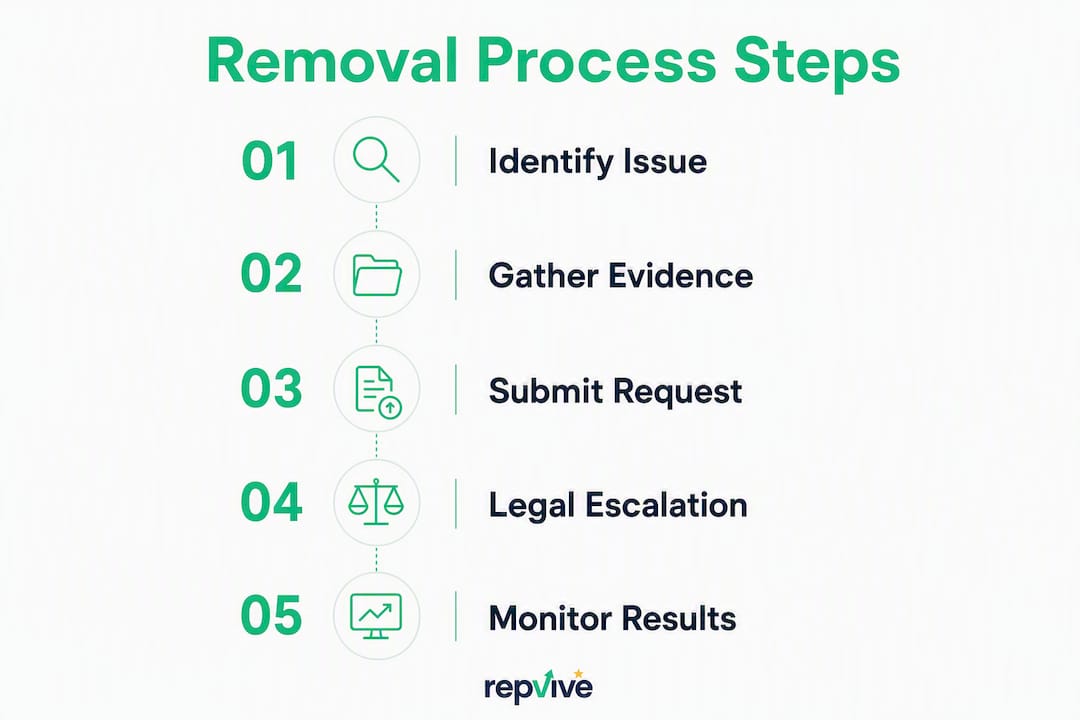
Legal tools exist on a spectrum from a cease-and-desist letter to a full defamation lawsuit, and the right choice depends on how strong your evidence is and how much harm the post is causing.
The main legal tools and when each applies:
- DMCA takedown: Use when the post reproduces copyrighted material you own (photos, written content). Fast and doesn’t require an attorney.
- Cease-and-desist letter: Useful as a first formal step when the author is identifiable and the content is clearly false. It signals intent without committing to litigation.
- Subpoena: Needed to unmask an anonymous author. Requires filing a John Doe lawsuit first, which takes time and money.
- Court order: The most reliable lever for removal or de-indexing. ComplaintsBoard’s own policy recognizes signed court orders as grounds for removal.
- Defamation lawsuit: Appropriate when the post contains a false statement of fact (not opinion), has caused measurable harm, and the author acted with negligence or actual malice depending on your plaintiff status under U.S. law.
A critical jurisdictional reality: ComplaintsBoard may operate under a non-U.S. corporate structure, which means a domestic court order can be less effective at forcing the site itself to remove content. The more practical outcome is using a U.S. judgment to compel search engines to de-index the offending URL. Google and Bing respond more readily to domestic judgments than foreign-hosted platforms do.
| Legal route | Typical timeline | Estimated cost range |
|---|---|---|
| DMCA takedown | Typically within days to a few weeks | Costs vary by service |
| Cease-and-desist letter | Generally a few weeks | Attorney fees vary |
| John Doe subpoena | Usually several months | Can involve substantial legal fees |
| Court order (defamation) | Often many months to over a year | Legal expenses can be significant |
| Search engine de-indexing (post-judgment) | Occurs after judgment within weeks | Typically covered as part of legal expenses |
Decision checklist: legal action vs. suppression:
- The post contains specific false statements of fact (not vague criticism or opinion)
- You can document measurable harm: lost contracts, revenue drop, client cancellations
- The post ranks on page one for your business name
- Direct requests to ComplaintsBoard have already failed
- You have the budget and timeline tolerance for litigation
If most of those boxes are checked, legal escalation is worth a serious conversation with an attorney. If only one or two apply, SEO suppression may deliver faster results at lower cost.
Pro Tip: For legal options around fake or defamatory reviews, the threshold question is always “false statement of fact vs. opinion.” Courts have consistently held that statements like “worst service ever” are protected opinion, while “they stole $500 from me” is a verifiable factual claim that can support a defamation action.
Should you hire an attorney-led removal service?
Attorney-led removal services do something a standard reputation management firm can’t: they build legally defensible claims, file formal notices with platforms, and coordinate with search engines using the kind of documentation that actually moves the needle. The difference shows up most clearly when a platform like ComplaintsBoard has already rejected a direct request.
When hiring makes sense:
- The post is clearly defamatory and causing measurable business harm
- You’ve already tried a direct request and been ignored
- The complaint ranks prominently for your name or business name
- You’re dealing with multiple complaints across platforms
- You don’t have the time or legal background to manage the process yourself
What a professional process typically looks like:
- Intake and evidence audit: The service reviews your documentation and assesses whether the content meets the legal threshold for removal
- Legal claim drafting: Attorneys craft a claim tailored to the specific platform’s enforcement categories (guideline violation, privacy breach, copyright, defamation)
- Platform escalation: Formal notices are submitted through the platform’s legal channels, not the standard support form
- Search engine coordination: If the platform doesn’t remove the post, the service pursues de-indexing with Google and Bing using the legal documentation already built
- Monitoring: Ongoing tracking to catch new complaints early
Attorney-led removal services work because they speak the platform’s enforcement language. A request framed around a legal claim, supported by documentation, and submitted through the right channel gets treated differently than a frustrated business owner’s support ticket. The legal framing is the mechanism, not just the credential.
Repvive operates on a pay-per-removal model with no upfront fees, which means you don’t pay until a removal is confirmed. The service covers more than 20 platforms, uses attorney-crafted legal claims for each piece of content, and provides a real-time tracking dashboard so you can see exactly where your case stands. Repvive also offers RepWatch and RepBoost for ongoing monitoring and new review generation, which matters because removal alone doesn’t protect you from the next complaint.
ComplaintsBoard’s own FAQ warns against services that promise paid removals without legal backing. That warning is aimed at scam operations, not attorney-led services that pursue legitimate legal and procedural channels. The distinction is whether the service is using enforceable legal mechanisms or just claiming to have “connections.”
Pro Tip: When evaluating any removal service, ask three questions: Do they use licensed attorneys? Do they charge only after a confirmed removal? Can they show you a dashboard or case log? If the answer to any of those is no or vague, keep looking.
What to do when removal isn’t possible
Removal fails more often than it succeeds. When it does, suppression is the next best move, and done well, it can push a ComplaintsBoard page off page one within weeks.
Quick controls to implement immediately:
- Request “resolved” status on the complaint to stop it affecting your rating
- Submit a personal data masking request for any sensitive fields in the post
- Claim and fully optimize your Google Business Profile so it outranks the complaint for branded searches
- Build out profiles on high-authority directories (BBB, Yelp, LinkedIn, industry associations)
SEO suppression approach:
- Publish a press release through a wire service (PR Newswire, Business Wire) targeting your business name as a keyword
- Create or update your official website’s About and Team pages with strong on-page SEO
- Build at least three high-authority third-party profiles (industry directories, local chamber listings, review platforms) with consistent NAP data
- Generate new positive reviews on Google, Yelp, and relevant platforms to shift the overall sentiment signal
Monitoring your branded search results is not optional once you’ve been targeted. Set up Google Alerts for your business name and key personnel, track your page-one results weekly, and keep your evidence log updated in case the situation escalates to legal action later.
Suppression is preferable to legal action when the post is opinion-based (not factually false), the harm is moderate rather than severe, or you need results faster than litigation allows. A well-executed suppression campaign can move a result off page one within a matter of weeks. A defamation lawsuit takes months to years.
Copy-ready templates for removal requests
Use these as starting points. Have an attorney review anything you plan to send as a formal legal notice.
Removal/edit request to ComplaintsBoard:
- Subject line: “Removal/Edit Request — [Your Business Name] — [Post URL]”
- Opening: “I am writing to request removal/editing of the complaint located at [exact URL], published on [date].”
- Basis: “The complaint contains the following false statement of fact: [quote exact text]. I am attaching [invoice/correspondence/contract] that directly contradicts this claim.”
- Specific request: “I request that the following text be redacted: [exact text to remove]. Alternatively, I request that the complaint be removed in full on the basis of [guideline violation / court order attached].”
- Closing: “Please confirm receipt of this request. I can be reached at [email/phone].”
DMCA takedown notice (abbreviated):
- Identify the copyrighted work and your ownership (registration number or creation date)
- Identify the infringing URL on ComplaintsBoard
- State: “I have a good faith belief that the use of the material is not authorized by the copyright owner, its agent, or the law.”
- Include your contact information and a physical or electronic signature
- Send to ComplaintsBoard’s designated DMCA agent (listed in their Terms of Service)
Cease-and-desist snippet (for attorney review):
Evidence checklist to attach to any request:
- Full-page screenshots with visible timestamps and URLs
- Transaction records, invoices, or contracts that contradict the post
- Correspondence log with the reviewer (if known)
- Any prior communications with ComplaintsBoard about this post
- Witness statements, if available and relevant
Pro Tip: Send your removal request via email AND through the support portal, and BCC yourself so you have a timestamped record of submission. If you later need to show a court or attorney that you attempted direct resolution, that paper trail matters.
Key Takeaways
A correctly formatted, evidence-backed request is the minimum viable first step; a court order or attorney-led escalation is the most reliable path to actual removal from ComplaintsBoard.
| Point | Details |
|---|---|
| Removal threshold is high | ComplaintsBoard only removes posts for guideline violations or a signed court order — not on request alone. |
| Edits and masking are available | Personal data masking and “resolved” status are accessible without legal action and reduce immediate harm. |
| Legal escalation targets search engines | A U.S. court judgment often leads to Google/Bing de-indexing rather than direct site removal, due to jurisdiction issues. |
| Suppression works as a fallback | Three or more high-authority assets (press, optimized pages, directories) can push a complaint off page one in weeks. |
| Repvive offers attorney-led removal | Repvive’s pay-per-removal model means no upfront cost; attorneys craft legal claims and pursue platform and search engine removal. |
The part most guides skip
The most common mistake businesses make with ComplaintsBoard is treating it like a Google review, where a simple flag sometimes works. It doesn’t work here, and the reason is structural: ComplaintsBoard’s entire value proposition to consumers is that complaints are permanent. That’s the feature, not a bug.
What that means practically is that your energy is better spent on two parallel tracks from day one: a correctly formatted legal request to the platform, and a suppression campaign that starts building authority content immediately. Waiting to see if the platform responds before starting suppression costs you weeks of ranking damage you can’t get back.
The attorney-led path through Repvive makes the most sense when the post is clearly defamatory and ranking visibly. The pay-per-removal model removes the financial risk of trying, and the legal framing of each claim is what separates a request that gets processed from one that gets ignored. For businesses that have already tried the DIY route and hit a wall, that difference in approach is usually what finally moves the needle.
Repvive handles the hard part of ComplaintsBoard removal
When a ComplaintsBoard post is ranking for your business name and direct requests have gone nowhere, the attorney-led route is the one that actually produces results. Repvive’s process starts with a no-cost evidence audit: attorneys review your documentation, assess whether the content meets the legal threshold for removal, and outline the specific legal path forward before you commit to anything.
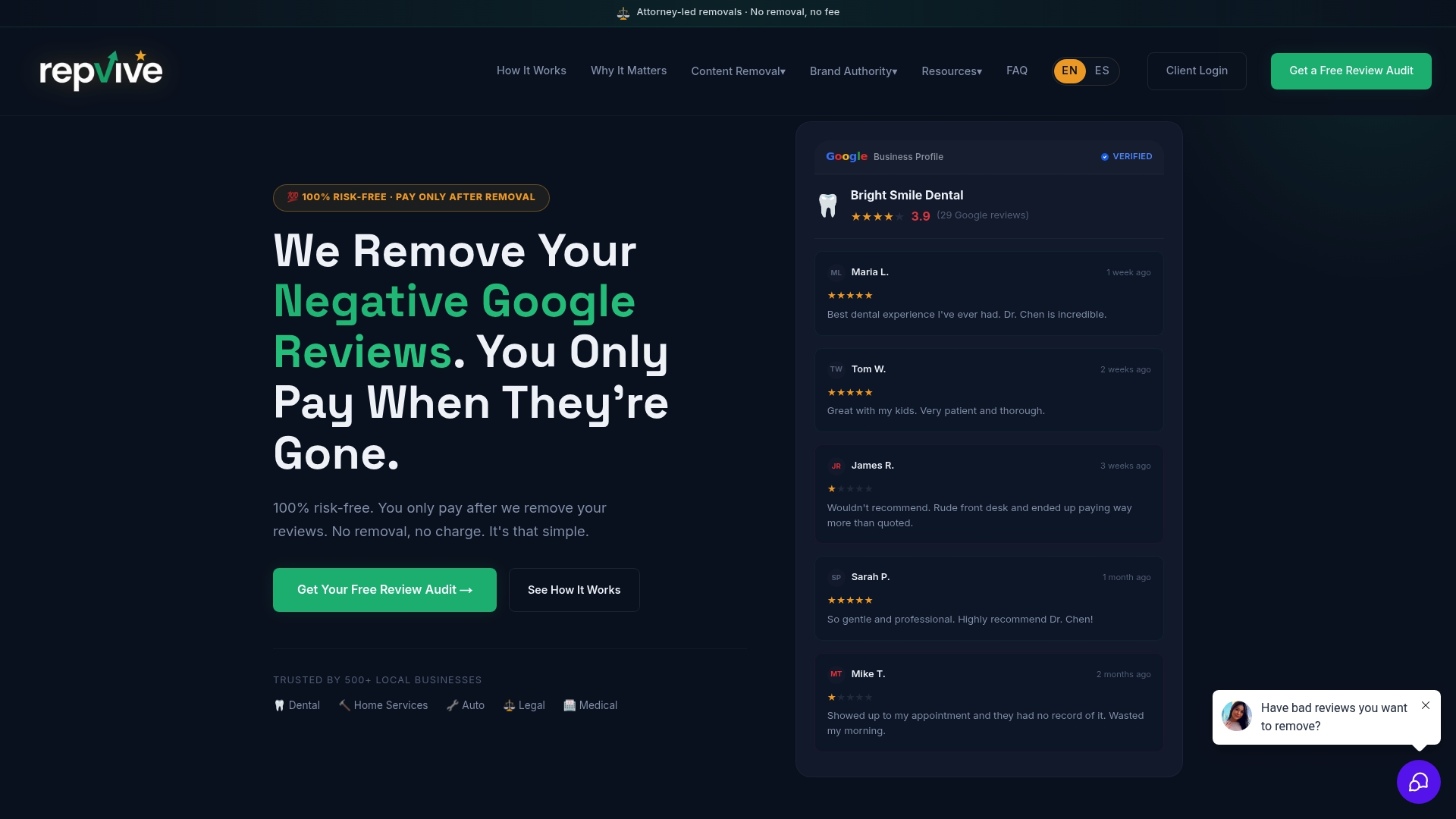
From there, Repvive drafts customized legal claims for each piece of content, submits through the right enforcement channels, and coordinates with search engines to pursue de-indexing when platform removal isn’t immediately achievable. The pay-per-removal model means you pay only after a confirmed removal, not before. Coverage spans more than 20 platforms, and the real-time dashboard keeps you informed at every step. RepWatch and RepBoost handle ongoing monitoring and new review generation so you’re protected going forward, not just today.
To get started, submit your complaint URL and basic business details through Repvive’s removal service page for a free evidence review and a clear assessment of your options.
Useful sources
- ComplaintsBoard FAQ: The platform’s official policy on removal, editing, personal data masking, and its stance on paid removal services.
- How to Remove Defamatory Reviews From ComplaintsBoard.com (Vorys): Practitioner-level legal analysis of court orders, jurisdiction issues, and search engine de-indexing as the practical outcome of U.S. litigation.
- How to Remove Defamatory Reviews From ComplaintsBoard.com (Lexology): Additional legal commentary on defamation thresholds and removal strategy for ComplaintsBoard specifically.
- Report inappropriate reviews on your Business Profile (Google): Google’s official process for flagging policy-violating reviews and how it differs from source-site removal.
- Repvive attorney-led removal service: Platform coverage, pay-per-removal model, and monitoring tools for businesses pursuing professional removal.
- Repvive BBB removal page: Platform-specific legal and procedural steps that parallel the ComplaintsBoard removal process.
FAQ
Can you remove a ComplaintsBoard post without a court order?
Rarely. ComplaintsBoard only removes posts for clear guideline violations or a signed court order; personal data masking and “resolved” status are available without legal action but don’t remove the post.
How long does ComplaintsBoard removal take?
A direct request with strong documentation may get a response within days to weeks; legal escalation through a court order often takes many months to over a year, with search engine de-indexing occurring after judgment within weeks.
Is ComplaintsBoard removal possible if the post is anonymous?
Yes, but it requires a John Doe subpoena to unmask the author first, which usually takes several months and involves substantial legal fees before a defamation claim can proceed.
What does Repvive charge for ComplaintsBoard removal?
Repvive operates on a pay-per-removal model with no upfront fees, meaning you are billed only after a removal is confirmed, not before the work begins.
Does marking a complaint “resolved” help your reputation?
It stops the post from affecting your ComplaintsBoard rating, but the original complaint text remains fully visible. Pairing “resolved” status with an active SEO suppression campaign produces a more meaningful impact on search visibility.