Angi vs HomeAdvisor: Remove Negative Reviews Legally
Angi vs HomeAdvisor: Remove Negative Reviews Legally
TL;DR:
- Removing a negative review from Angi or HomeAdvisor is only possible if it violates their platform rules, such as fake accounts or threats. Responding promptly with a professional public reply and providing strong evidence increases the chances of removal, especially when DIY attempts fail. Attorney-led services often achieve higher success rates for clearly fake or defamatory reviews, bypassing platform discretion with legal claims.
You can sometimes remove a review from Angi or HomeAdvisor, but only when the content breaks their platform rules. Platforms hold all the discretion here — businesses have no automatic right to removal. Your first 30 minutes matter most: screenshot everything, post a calm public reply, and file a removal request through the Pro dashboard. According to BrightLocal’s 2025 consumer survey, 88% of consumers would use a business that replies to all reviews versus 47% for those that don’t respond at all. That gap alone justifies going public with a professional response even while you pursue removal behind the scenes.
Immediate actions to take right now:
- Screenshot the review with the URL, date, and reviewer profile visible
- Post a brief, professional public reply within 24 hours
- Pull transaction records, invoices, or booking confirmations tied to the reviewer
- Flag the review through your Pro or Business dashboard
- Note whether the reviewer appears in your CRM as an actual customer
Table of Contents
- How do Angi and HomeAdvisor policies compare on review removal?
- Step-by-step: how to respond publicly and request removal
- When is removal actually realistic?
- What are your escalation options beyond a platform flag?
- How do you choose a review-removal provider?
- Ready-to-use templates for public reply, outreach, and removal requests
- Key Takeaways
- Why attorney-led removal often outperforms a platform flag
- Repvive handles the legal heavy lifting so you don’t have to
- Useful sources and further reading
- FAQ
How do Angi and HomeAdvisor policies compare on review removal?
Both platforms reserve removal as their own call, not yours. Angi’s terms state the platform “may, in its sole discretion, choose to remove or not to remove reviews and ratings once published.” HomeAdvisor’s content guidelines mirror that language almost exactly, reserving “the right, but not the obligation” to remove content it determines violates its rules.
The practical difference between the two platforms comes down to verification. Angi uses a verified-transaction model for many reviews, which means a reviewer’s purchase history is sometimes tied to their account. That creates a paper trail you can challenge. HomeAdvisor’s review system is less tightly coupled to verified transactions, so evidence of non-customer status requires more documentation on your end.
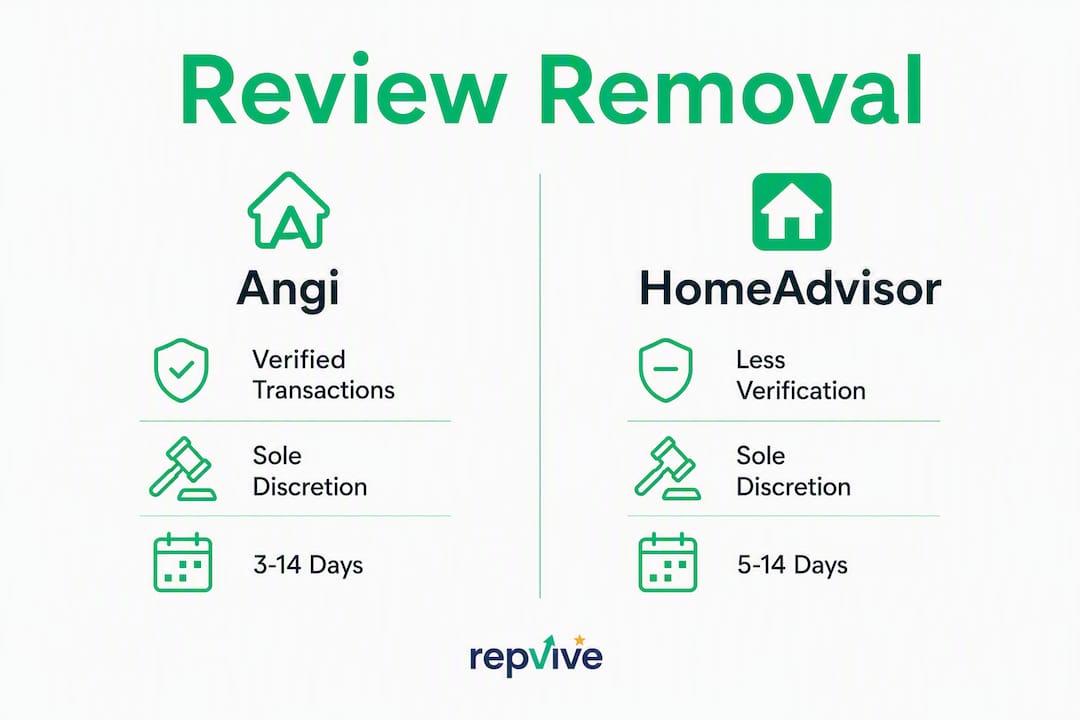
| Dimension | Angi | HomeAdvisor |
|---|---|---|
| Can the platform remove? | Yes, at sole discretion | Yes, at sole discretion |
| Grounds required | Fake/spam, competitor sabotage, threats, privacy violations, wrong business profile | Same, plus reviews with no qualitative value or addressing a different service professional |
| How to request | Flag via Pro dashboard; email support with evidence | Flag via Business Center; contact support with documentation |
| Evidence accepted | Invoices, booking IDs, communications proving non-customer | Transaction records, message logs, proof of misattribution |
| Typical timeline | 3–14 business days | 5–14 business days |
| When to escalate | After two failed platform requests | After two failed platform requests |
Step-by-step: how to respond publicly and request removal
1. Write your public reply first. Acknowledge the complaint by name (“We’re sorry to hear about your experience with our roofing crew on March 4th”), correct any factual errors briefly, and offer to resolve privately. Response timing and specificity both affect moderator perception — a generic “sorry you feel that way” reply signals you haven’t investigated.

2. Preserve all evidence before filing anything. Take full-page screenshots with timestamps. Export the relevant invoice, booking confirmation, or CRM record. If the reviewer’s name doesn’t match any customer in your system, document that gap explicitly.
3. Flag the review through the platform dashboard. In Angi’s Pro Center, navigate to the review, select “Report Review,” and choose the violation category that fits. In HomeAdvisor’s Business Center, the path is similar. Be specific — “this reviewer was never a customer” with an attached invoice is far stronger than selecting “inappropriate content” with no documentation.
4. Attach your evidence file. Platform removal decisions are discretionary, and high-quality documentary evidence materially increases the chance of moderator action. A single PDF combining the invoice, a screenshot of your booking system showing no match, and a timestamped photo of the completed job is more persuasive than three separate uploads.
Evidence checklist:
- Invoice or receipt with customer name and service date
- Booking confirmation or CRM record (or documented absence of one)
- Photos of completed work with embedded timestamps
- Any written communications with the reviewer
- Proof the review describes a different business (if misattributed)
Pro Tip: Never contact the reviewer through the platform’s public comment thread. Send a private message through the platform’s messaging tool if available, or use contact info from your records. Avoid any language that sounds like you’re offering compensation for removal — that violates both platforms’ policies and the FTC’s endorsement guidelines.
When is removal actually realistic?
Removal on Angi is generally limited to content that breaks Community Guidelines, and HomeAdvisor follows the same logic. Honest negative feedback, even if it stings, is protected. Moderators are not in the business of helping you bury legitimate complaints.
Categories that typically qualify for removal:
- Fake accounts or spam profiles with no transaction history
- Competitor sabotage (a rival business posting as a customer)
- Threats, harassment, or personal attacks against staff
- Doxxing or exposure of private personal information
- Content clearly posted to the wrong business profile
- Reviews describing services you demonstrably never provided
A one-star review from a real customer who had a bad experience? That stays. Platforms protect verified negative feedback because their consumer trust depends on it. Both Angi and HomeAdvisor require clear policy violations before deleting honest negative feedback.
On the legal side, defamation litigation is expensive, slow, and public. Internet-law attorneys advise that filing suit can amplify a negative review’s visibility rather than suppress it. Run a cost-benefit analysis before escalating: a $200 review response service is a different calculation than a $15,000 lawsuit.
What are your escalation options beyond a platform flag?
When two platform requests fail and the review is clearly fake or defamatory, three paths exist.
| Approach | When it fits | Pros | Cons | Timeline | Cost range |
|---|---|---|---|---|---|
| Negotiate directly | Genuine misunderstanding; reviewer reachable | Fast, private, no legal fees | Reviewer may refuse; can’t offer payment for removal | Days to weeks | — |
| Cease-and-desist letter | Identifiable reviewer, clear false statements | Signals seriousness; often prompts removal | No guarantee; may escalate conflict | 2–6 weeks | — |
| Attorney-led removal service | Strong evidence of fake/defamatory review | Higher success rate, legal claims tailored per review, pay-per-removal | Cost per removal | 24 hours–4 weeks | Varies by provider |
| Defamation litigation | Severe financial harm, identifiable defendant | Potential damages award | Expensive, public, slow | Months to years | — |
Section 230 gives platforms broad immunity from third-party content, so legal claims almost always target the individual reviewer rather than Angi or HomeAdvisor directly. When a reviewer is anonymous, attorneys can file a John Doe complaint and seek a subpoena to unmask them — but courts typically require prima facie evidence of defamation before ordering disclosure.
Repvive’s attorney-led model fits the middle ground: strong evidence of a fake or defamatory review, no appetite for full litigation, and a preference for paying only when the removal succeeds. Their Angi and HomeAdvisor removal service uses legal claims tailored to each review rather than generic platform flags, which is why Industry data shows professional services report success rates of 80–92% for clear guideline violations, while DIY flagging alone results in success rates of 25–40%.
How do you choose a review-removal provider?
Not every removal service operates the same way. Some use gray-hat tactics that violate platform terms and can get your business profile suspended. Here’s how to vet one properly.
Questions to ask during the sales call:
- Do you charge upfront, or only after successful removal?
- What exact evidence will you submit to the platform?
- What is your documented success rate for Angi and HomeAdvisor specifically?
- Do you use legal claims, platform flags, or both?
- What happens if the removal fails — do you refund or retry?
- Will you ask me to post fake positive reviews or contact the reviewer with payment offers?
- How long does a typical case take from submission to decision?
Red flags that should end the conversation:
- Promises of guaranteed removal before reviewing your evidence
- Claims of “special access” to platform moderators
- Instructions to fake positive reviews to dilute the negative one
- Requests to offer the reviewer money, discounts, or gifts in exchange for deletion
- No written contract or refund policy
Higher pricing is sometimes justified when a case requires John Doe discovery, ISP subpoenas, or multi-platform escalation. A flat $99 fee and a $2,500 legal unmasking case are genuinely different products.
Ready-to-use templates for public reply, outreach, and removal requests
Public reply template: “Thank you for sharing your feedback. We take every experience seriously and are sorry to hear this didn’t meet your expectations. We’ve reviewed our records from [date] and would like to address your concerns directly. Please reach out to us at [contact info] so we can make this right.”
Private outreach message: “Hi [Name], I’m [Your Name] from [Business]. I saw your review and want to understand what happened. We have no record of a service matching your description — could you help us identify the visit so we can investigate? I’m happy to call at your convenience.”
Platform removal request text: “This review appears to violate [platform] Community Guidelines. The reviewer is not in our customer records for the date referenced. Attached: invoice log showing no matching transaction, CRM export for the date range, and timestamped job-completion photos. We request removal under the [fake review / misattribution / harassment] category.”
Attachments checklist:
- Invoice or receipt (PDF, showing customer name and date)
- CRM export or booking log for the relevant date range
- Job-completion photos with embedded timestamps
- Written communications with the reviewer (if any)
- Proof of misattribution (if the review describes a different business)
Pro Tip: When capturing screenshots for evidence, use your browser’s full-page capture tool (Firefox has one built in; Chrome extensions like GoFullPage work well) so the URL, timestamp, and reviewer profile are all in one image. Courts and platform moderators both prefer a single authenticated capture over cropped screenshots.
Key Takeaways
Removal is possible only when a review breaks platform rules — preserve evidence, respond publicly within 24 hours, and escalate to attorney-led removal when DIY flags fail.
| Point | Details |
|---|---|
| Respond within 24 hours | 88% of consumers prefer businesses that reply to all reviews; a public response protects reputation while removal is pending. |
| Evidence determines outcomes | Invoices, booking IDs, and timestamped photos materially increase moderator action on both Angi and HomeAdvisor. |
| DIY flags have limits | DIY flagging achieves removal in 25–40% of cases, while professional attorney-led services succeed 80–92% of the time for clear guideline violations. |
| Litigation is a last resort | Defamation suits are expensive and can amplify a review’s visibility; a cease-and-desist or negotiated removal is usually faster. |
| Repvive for escalation | Repvive’s attorney-led model offers a practical middle ground between DIY flags and full litigation. |
Why attorney-led removal often outperforms a platform flag
Most business owners assume a platform flag is the logical first move, and it is — but it’s also where the process usually stalls. Angi and HomeAdvisor moderators review hundreds of flags daily. A generic “this review is fake” submission with no documentation lands at the bottom of that queue, and Section 230 immunity means the platform has no legal obligation to act on it.
What changes the outcome is a legal claim that maps the review to a specific violation, attaches documentary evidence, and signals that the submitter understands the platform’s own terms. That’s the difference between a flag and an attorney-crafted removal request. When the reviewer is anonymous, a John Doe subpoena can unmask them — but courts require prima facie defamation evidence first, which is exactly the kind of threshold a legal team is equipped to meet. Legal options for fake reviews are more accessible than most owners realize, especially under a pay-per-removal model where you carry no financial risk until the review is actually gone.
Repvive handles the legal heavy lifting so you don’t have to
When a platform flag fails and the review is clearly fake or defamatory, the next call shouldn’t be to a general reputation management agency. Repvive’s attorney-led removal service was built specifically for this situation: a legal team reviews your case, builds a customized claim for each review, and submits it through direct channels — not a generic form.
What’s included:
- Case review and evidence bundling
- Attorney-crafted legal claims tailored to each review
- Platform escalations for Angi, HomeAdvisor, Google, Yelp, and 20+ other sites
- Real-time tracking dashboard so you know exactly where your case stands
- John Doe discovery support for anonymous reviewers when needed
- No upfront fee — you pay only after successful removal
Repvive works with contractors, dental practices, auto shops, restaurants, and law firms across the United States. Most standard cases resolve in 24 hours to four weeks. If removal isn’t achieved, you owe nothing. Start your case review at repvive.co to see whether your review qualifies.
Useful sources and further reading
- Angi Terms of Service — Platform language on discretionary removal and review submission rules
- Angi Legal Center — Full review policy, including prohibited content categories
- HomeAdvisor Legal Center — Content guidelines and removal discretion language
- BrightLocal — Reviews and the Law: What US Businesses Need to Know — Consumer survey data on review response impact and FTC compliance
- KJK — Can My Business Sue Over Negative or Fake Online Reviews? — Attorney guidance on defamation litigation costs and alternatives
- Revision Legal — Removing Online Defamatory Content: Your Legal Options — Section 230 explained and legal escalation paths including John Doe suits
This article provides general information, not legal advice. Platform policies and defamation law vary by circumstance — confirm current rules with the platform directly or consult a qualified attorney before taking legal action.
FAQ
Can you remove a negative review from Angi or HomeAdvisor?
Yes, but only when the review violates platform policies — fake accounts, competitor sabotage, threats, or misattribution. Honest negative feedback from real customers is generally protected and will not be removed.
What evidence do Angi and HomeAdvisor accept for a removal request?
Both platforms respond best to invoices, booking confirmations, CRM records showing no matching customer, timestamped job photos, and written communications that contradict the reviewer’s claims.
How long does Angi or HomeAdvisor take to act on a removal request?
Angi typically takes 3–14 business days; HomeAdvisor runs 5–14 business days. Cases with strong documentary evidence tend to resolve faster.
When should I use an attorney-led removal service instead of DIY flagging?
When two platform flags have failed, the review is clearly fake or defamatory, and the financial or reputational damage justifies the cost. Repvive’s pay-per-removal model removes the financial risk — you pay only after the review is gone.
Does responding to a negative review help my business?
Yes. BrightLocal’s research shows 88% of consumers would use a business that replies to all reviews, compared to 47% for businesses that don’t respond. A professional public reply protects your reputation while a removal request is pending.